When it comes to AI, we usually think of Blackstone buying a data center campus or maybe a power plant and cooling supplier.
It’s a little more of a stretch to get from there to an investment firm financing the riskiest slice of a roughly $60 billion debt package to pay for the chips Anthropic needs to train and run Claude.
But that’s exactly what Blackstone is doing, according to an October 2 Bloomberg report.
Blackstone is leading the Class B junior tranche of the roughly $60 billion debt package to fund Anthropic. The package is structurally split into two layers, a $42 billion Class A tranche that is senior and secured and an $18 billion Class B tranche that is junior, with the Class A tranche being led by banks, who will get repaid first.
Blackstone is putting about $9 billion of its own funds into the Class B tranche and plans to sell the remaining $9 billion to other investors.
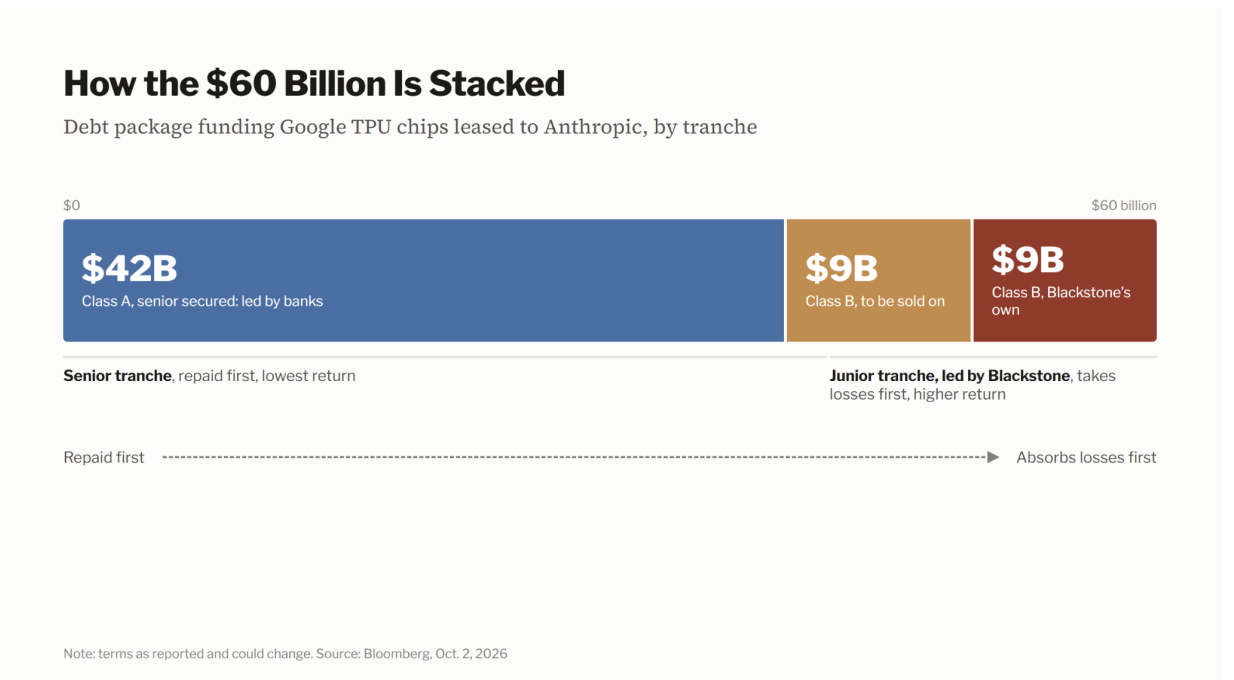
Banks hold the $42 billion senior slice and get repaid first; Blackstone leads the $18 billion junior slice, putting in about $9 billion of its own money.
Who Owns the Chips
Anthropic relies on a special financing structure to get these chips. Bits of plastic and silicon don’t come cheap. Thus, rather than Anthropic purchasing the hardware outright, a special-purpose vehicle raises the debt, uses the loan to buy the chips, then leases them to Anthropic, using lease payments to pay off lenders. Broadcom, which co-designs Google’s Tensor Processing Units, sells the chips to the special-purpose vehicle and helps arrange the financing. Earlier Bloomberg reporting, summarized by The Next Web in August, laid out this structure.
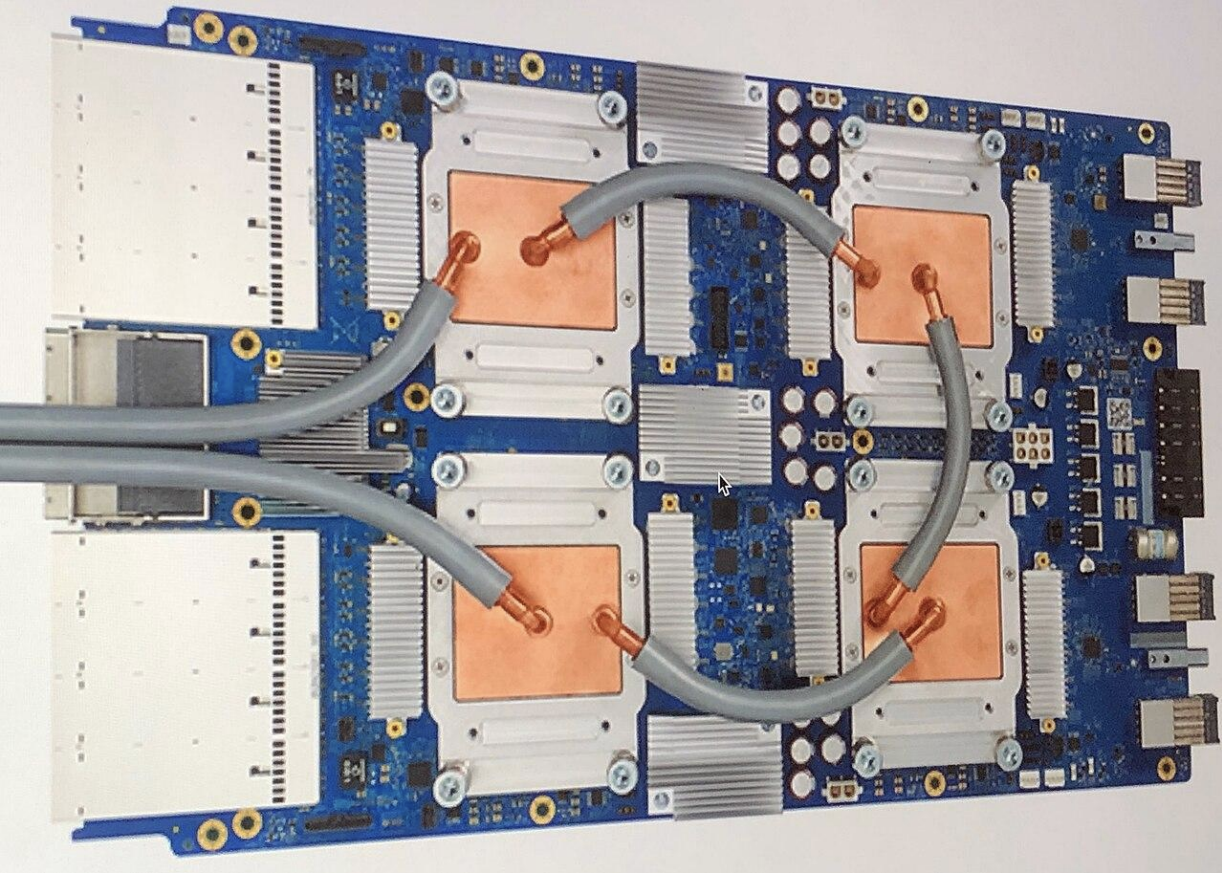
A Google Tensor Processing Unit board, its four chips cooled by liquid lines. Anthropic is leasing capacity built on later versions of the chip through a roughly $60 billion debt package.
According to the October reports, the money will cover about a third of Anthropic’s $125.2 billion, five-year commitment for TPU capacity, including 3.5 gigawatts of capacity starting in 2027, about the output of three and a half large nuclear reactors.
Broadcom partnered with investment firms Apollo and Blackstone in June to create AI XPV, which will fund deals like this one. Its first deal raised $35 billion, and the partnership hopes to finance more than 20 gigawatts of computing power by 2028.
Broadcom is both Anthropic’s supplier and architect of the debt that pays for its chips.
Why the Junior Seat
Indulging in the junior tranche may not have been the most obvious choice for a $1.3 trillion firm that typically prizes downside protection, but the attractive spread over the less risky debt and a need for large, long-dated assets is something Blackstone’s credit business has spotted before. Reports that the debt could convert into Anthropic shares also hint at a search for equity upside in the race to build frontier AI. The Broadcom financing complements the stakes that BXN1, the San Francisco unit led by Jas Khaira, is amassing in AI and growth technology, including stakes in rivals Anthropic and OpenAI. In May, Blackstone also wrote a big $5 billion equity check to partner with Google in an AI compute venture. And in September, it agreed to buy Flow Control Holdings, a Cincinnati maker of the liquid-cooling parts that keep chips like these from overheating, adding another piece of the AI supply chain.
The Risk in the Middle
The hard question is what happens if Anthropic’s growth slows. The lenders are protected by the chips themselves, but that protection is weakest exactly when it is needed. If Anthropic struggled to make its lease payments, the market for used AI accelerators would probably be soft at the same moment, because whatever slowed Anthropic would likely hit other buyers too. Lenders call this wrong-way risk: the borrower’s trouble and the collateral’s value move together. Broadcom carries a second version of it, since a weaker Anthropic would also mean fewer chip orders.
That dynamic has a familiar precedent. Around 2000, telecom equipment makers such as Lucent and Nortel lent heavily to their own customers so those customers could keep buying gear. When the customers failed, the suppliers lost the loans and the sales together. Hence, this deal is built more carefully, with outside lenders holding most of the risk and a large, fast-growing borrower, but the basic pattern of a supplier financing demand for its own product is the same.
Anthropic is aware of Broadcom’s double role. The company confidentially filed a draft prospectus in June, and according to Reuters, which reviewed it in late September, the filing flags the potential for conflicts of interest when Broadcom, as the chip vendor, also plays the role of financier. Broadcom is also Anthropic’s single biggest commitment: $161.2 billion of the $518 billion in cloud, compute and infrastructure commitments, ahead of Google at $111.1 billion and Amazon at $110 billion. Roughly 80 percent of that $518 billion can’t be cancelled. Against that, Anthropic generated about $4.59 billion of revenue in 2025, and separate press reports put its annualized run rate at about $65 billion by the end of July. So if repayments depend on growth, Anthropic has to keep growing.
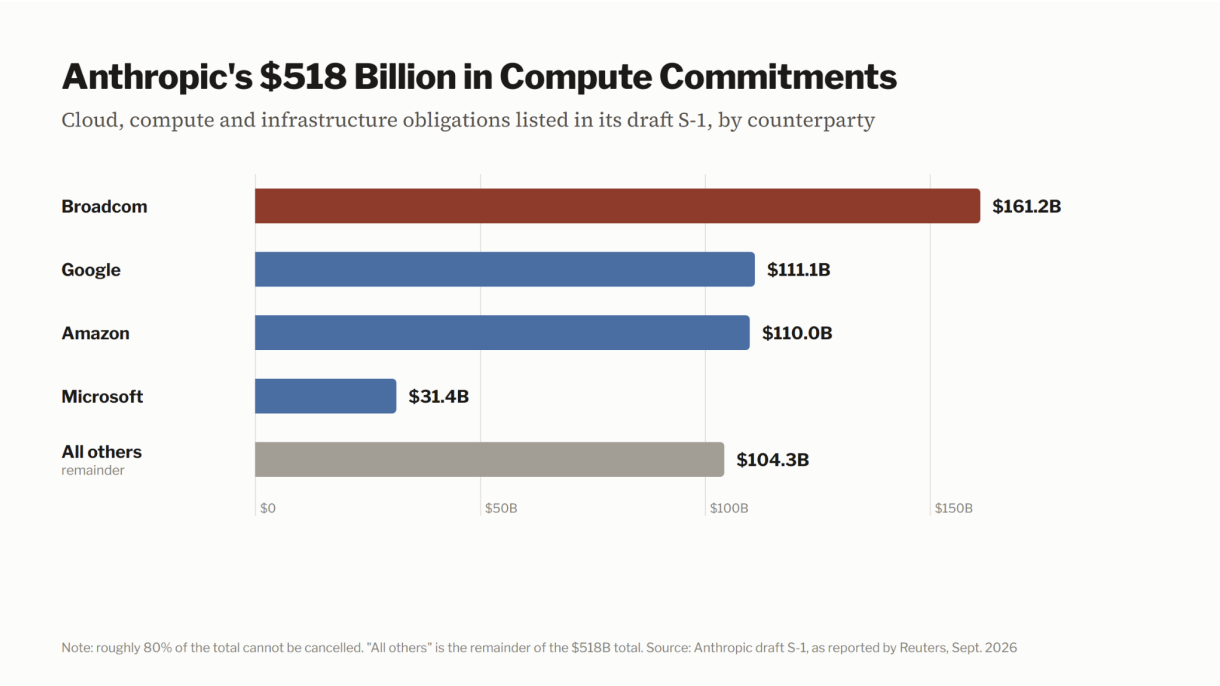
Broadcom accounts for the largest share of Anthropic’s $518 billion in compute commitments, ahead of Google and Amazon.
What to Watch
Three things. First, how quickly Blackstone finds someone to take the other $9 billion of its junior slice, and at what price. Word of that will go a long way to revealing how checkered the path to financing AI really is. Second, the public version of Anthropic’s prospectus, which will reveal the exact terms of the lease and conversion feature, though we may have to wait a while. Third, whether those 3.5 gigawatts are actually up and running in 2027.
In my opinion, venture funding usually works for the first phase of an activity. In the case of the AI boom, the first phase was paid for by venture capital and the cash flow of the largest tech companies. Now, the next phase will be paid for with long-dated private credit. Blackstone has decided to pick the seat with the most risk and the most upside.