The CoreWeave Problem
The clearest catalyst is sitting in the credit markets. One case study is CoreWeave, the AI cloud computing provider that rents out GPUs to the industry’s biggest names. The company has roughly $50 billion in debt and lease obligations (CNBC). Its stock fell about 25% in a single week this month, and some of its unsecured bonds are trading at distressed levels below 80 cents on the dollar as yields on its debt spiked toward 16% (Forbes, CNBC). Credit default swap spreads tied to CoreWeave widened sharply, with one Evercore trading desk bluntly summarizing that the markets are “saying ‘no mas’ to AI debt without operating cash flow support” (CNBC).
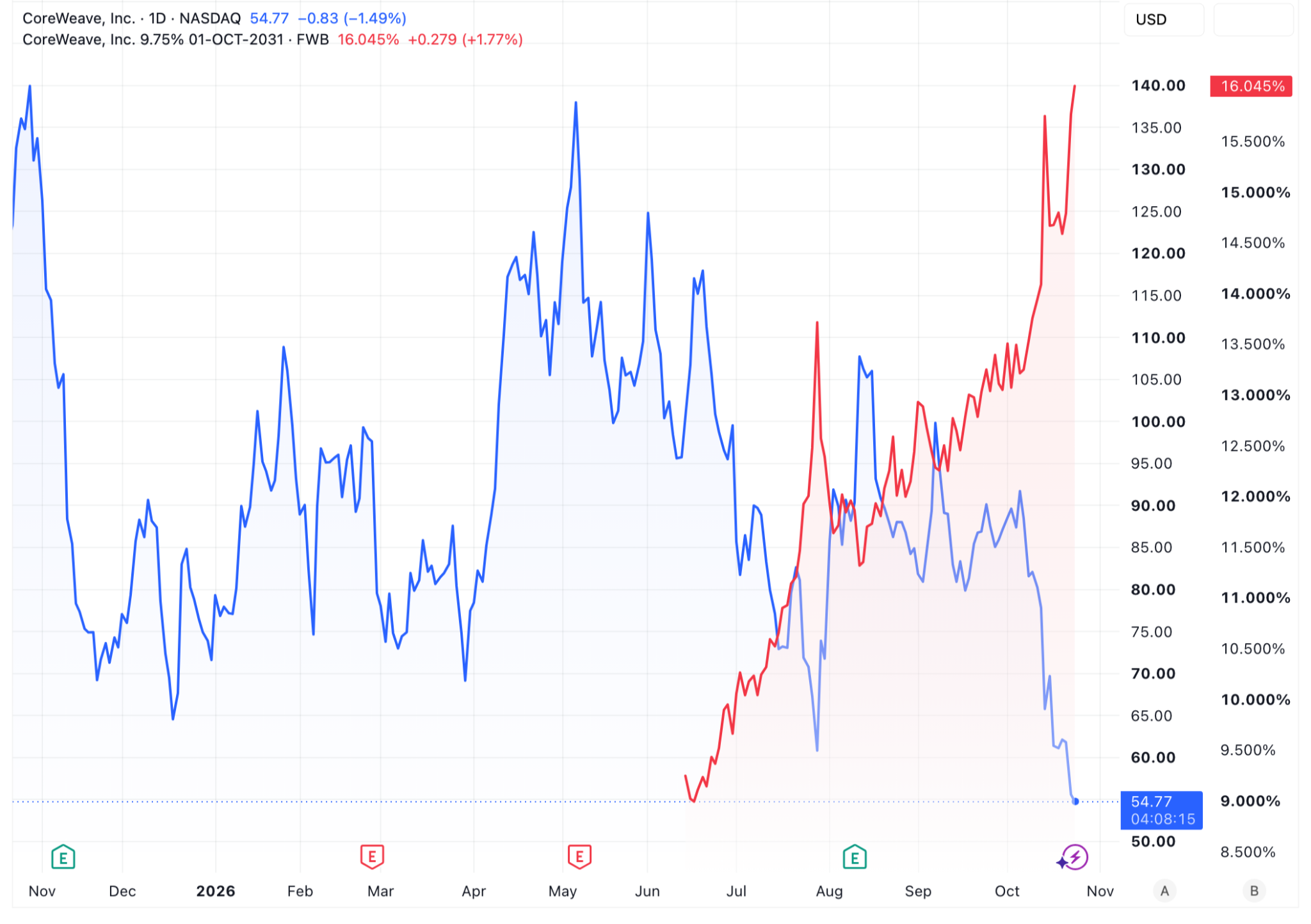
LTM CoreWeave Stock (USD) and 9.75% 2031 Bond (YTW) (TradingView).
Not everyone agrees this marks a systemic turning point for the AI outlook. JPMorgan is arguing that the selloff is overdone, noting that CoreWeave’s financing problems stem from rapid expansion rather than weak underlying economics. Goldman Sachs even upgraded the stock to Buy mid-selloff (Bloomberg, CNN). CoreWeave’s revenue backlog sits near $104 billion, and Q2 revenue grew 112% year over year (Fool.com). However, other AI infrastructure companies like Nebius and IREN are seeing similar drops, suggesting a broader sector cash-flow issue.
What CNN’s Indicators Are Picking Up
The options and volatility data back up the credit story. The 5-day average put/call ratio has moved into bearish territory, meaning traders are paying a premium for downside protection (CNN). The VIX is running well above its 50-day moving average, a classic signal that the market expects more turbulence ahead rather than a return to calm (CNN).
Not everyone agrees this marks a systemic turning point for the AI outlook. JPMorgan is arguing that the selloff is overdone, noting that CoreWeave’s financing problems stem from rapid expansion rather than weak underlying economics. Goldman Sachs even upgraded the stock to Buy mid-selloff (Bloomberg, CNN). CoreWeave’s revenue backlog sits near $104 billion, and Q2 revenue grew 112% year over year (Fool.com). However, other AI infrastructure companies like Nebius and IREN are seeing similar drops, suggesting a broader sector cash-flow issue.
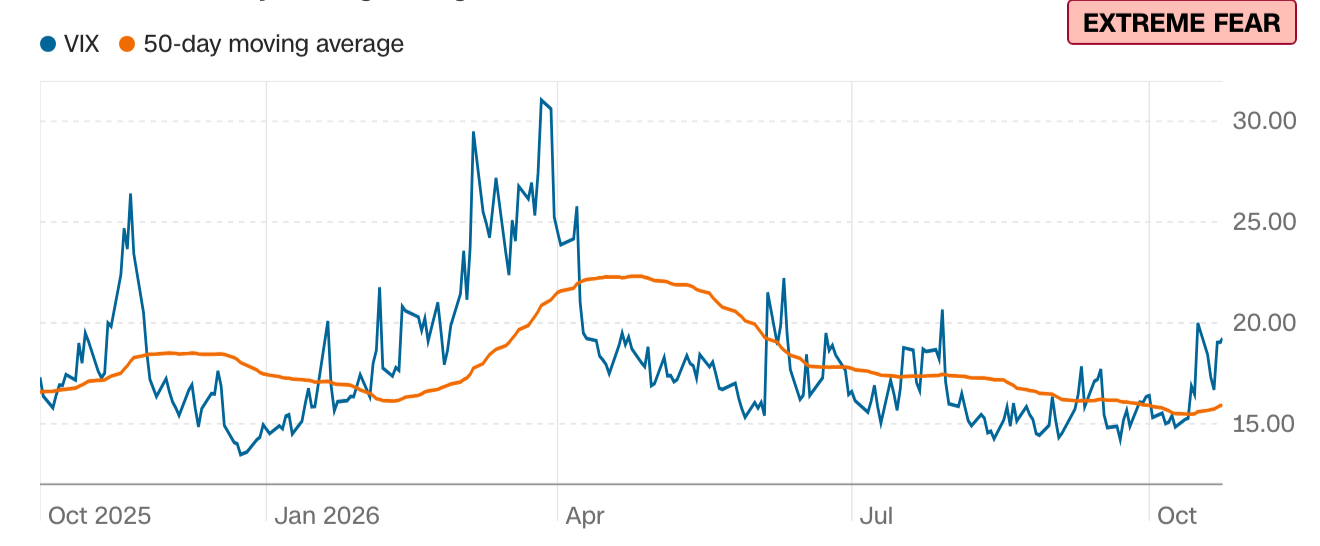
VIX 50 Day moving average (CNN).
Safe haven demand is elevated too. Treasury bonds have outperformed stocks over the past 20 trading days, which is exactly what happens when capital would rather sit somewhere boring than chase returns in this environment (CNN). Even market breadth is weak, with the number of NYSE stocks hitting 52-week highs having fallen below the number hitting 52-week lows. This isn’t a story about a handful of AI names dragging the index down; the selling is broader than that (CNN).
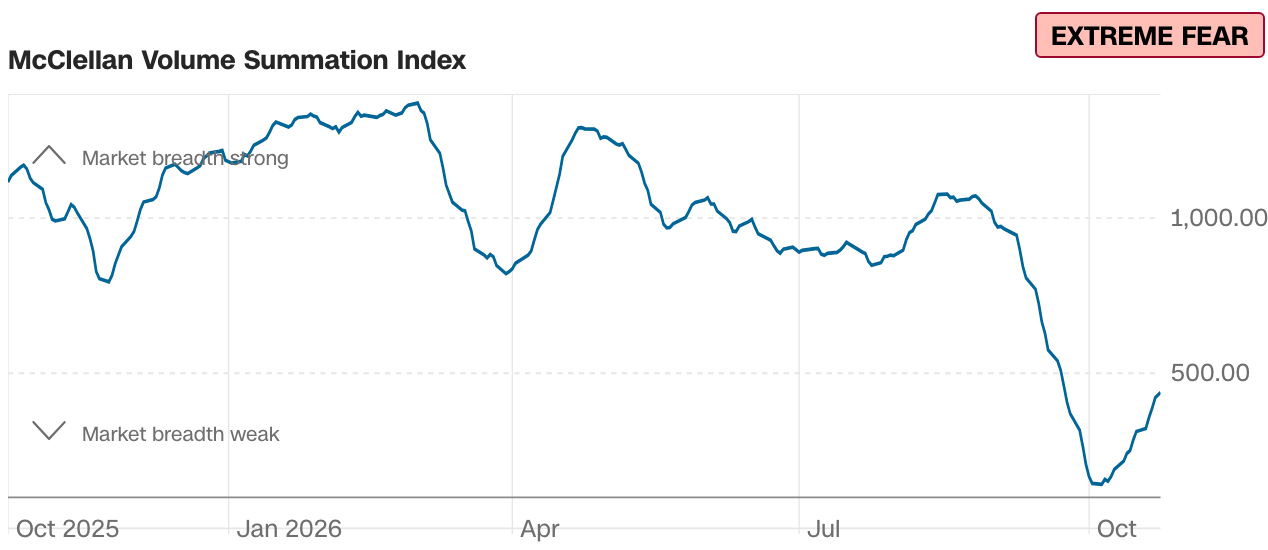
Stock price breadth displaying the volume of shares rising vs. volume of shares falling (CNN).
The Fiscal and Political Overhang
The federal budget deficit hit nearly $2 trillion for the fiscal year ending September 30th. That’s the largest since the pandemic and 12% higher than the prior year (CNN). Net interest payments on the public debt topped $1 trillion for the first time, more than the government spent on anything besides Social Security and Medicare (CNN). With midterms on November 3rd and markets already pricing in a divided Congress, strategists warn that a split government is more likely to produce budget standoffs and shutdown threats than fiscal consolidation (Investec, JPMorgan Asset Management). The S&P 500 is down 1.4% from its October record, and the Nasdaq 100 has fallen roughly 6% from its early-October high on weakness in AI and semiconductors (Archyde).
So Is This “Overblown?”
Not entirely. Extreme Fear readings have historically functioned more as contrarian signals than as confirmation a crash is coming. A lot of bad news tends to be already priced in by the time sentiment bottoms out. The speed of the move matters more than the level: going from Fear to Extreme Fear in a month. This credit event, a record deficit, and election uncertainty are landing simultaneously, driving faster deterioration than typical noise.
Outlook
None of the three stressors—AI financing risk, the fiscal picture, or election uncertainty—will resolve quickly. Watch CoreWeave’s bond yields over the next few weeks as a better indicator. If they stabilize, credit markets will likely see this as company-specific rather than systemic. If the contagion spreads to other leveraged AI infrastructure names, Extreme Fear likely has further to run. Until then, treat this as a market pricing in uncertainty rather than panic. Established names may get dragged down by sentiment, but will not be an immediate reason to exit broadly.