Over the past two years, Software as a Service (SaaS) stocks have suffered one of their sharpest downturns in history. More than $300 billion in value has been wiped from the S&P in the software and data sector, with major names like Adobe (ADBE) and Salesforce (CRM) both down about 43% on a TTM basis. Investors have dubbed this collapse the “SaaSpocalypse,” raising the question of whether this represents a temporary correction or a permanent decline.
Interestingly, most SaaS companies remain financially healthy, with revenues growing and strong free cash flows. Thus, the selloff doesn’t stem from a deteriorating business model or declining demand, but from growing uncertainty regarding how durable these cash flows will be in a world increasingly shaped by artificial intelligence.
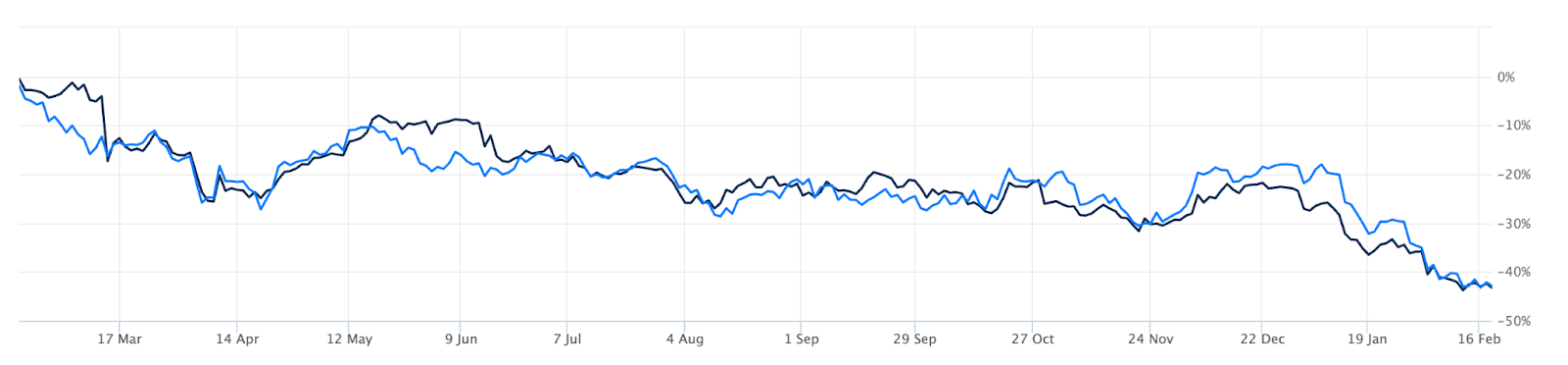
TTM Performance of Salesforce (Blue) and Adobe (Black), showing sharp valuation declines – WSJ
For a long time, SaaS companies traded at premium multiples, often 25x to 30x free cash flow, because their subscription models produced predictable, long-term earnings. Yet artificial intelligence has introduced a new headwind: it automates tasks once exclusive to software platforms. Thus, investors are forced to consider how much of today’s core software will still matter in ten years. When future relevance becomes uncertain, valuation collapses; as a result, most SaaS firms trade at 12x-15x free cash flow, reflecting investors’ perception of greater risk to long-term profitability.
Yet, core software is not easily replaced, as systems that manage customer data, billing, and compliance are deeply embedded in business operations, and companies are unlikely to trust untested AI tools with critical functions. Similarly, high switching costs and proprietary data will continue to protect leading platforms.
Therefore, SaaS is not disappearing; instead, the profit pool available to software is decreasing, and the profit pool available to the agentic layer, where AI is becoming increasingly dominant, is capturing more value. Hence, the path forward for SaaS companies is clear: they must prove that AI strengthens their products rather than undermines them. Only those that succeed will retain investor confidence, because while SaaS is not dead, the era of automatic premium valuations is over.