I saw some conversation on Twitter this week about statistical models versus prediction markets, specifically regarding the midterm election results. If you want to know the true odds of a big election happening in a few months, you should check Nate Silver. If you want to know the true odds of a big election happening next week, it’s better to check Kalshi or Polymarket. It’s not because the sharps aren’t playing early; they start loading during the summer, entering at very low prices. Because liquidity was thin over the summer, you don’t really see a large amount of money going in at once, though I was tracking accounts that were going in for longer trades. And that’s not including their alts, which is just having multiple crypto wallets—that’s what a lot of people do in memecoins, and they usually go through a washer, so it’s hard to track the transactions. If you’re selling a contract on the day of the election, you’re not going to sell it cheap. You’re going to sell it at a price that you believe is fair.
On Polymarket, every wallet’s on-chain transaction history is public. You can just look at the PnL graphs of the holders on either side. Retail priced a GOP hold, but I knew the 600,000-share whale wouldn’t buy into a losing position. I booked profits before results were certified: once a contract reprices from 20-40 cents to 75-90 cents, upside is capped, and election certification locks up capital. Polymarket’s order book data reveals that retail bettors were consistently less informed than sharps. The Republican side of the market was more overvalued than the Democratic side, and Polymarket’s retail traders bought into the overpricing. This is largely consistent with crypto users leaning right.
In the Michigan Senate race, Dem primary loser Haley Stevens endorsed Republican Mike Rogers over Dem nominee Abdul El-Sayed. This received more attention than it deserved. Why? The order book. Retail bettors overreact to cheap talk headlines. Sharps track costly signals (money or careers on the line). If Haley Stevens had a personal movement like Obama, Bernie Sanders, or Zohran Mamdani, her endorsement of Rogers would have meant something. But she’s a generic moderate. Nearly every major Democrat backed El-Sayed. Endorsing a Republican hurt Stevens with her own voters more than staying neutral. The Nov. 1 NYT/Siena Michigan poll found El-Sayed winning 96% of Democrats (to 3%), leading Independents 54% to 37% (+17), and leading 2024 non-voters 46% to 36% (+10).
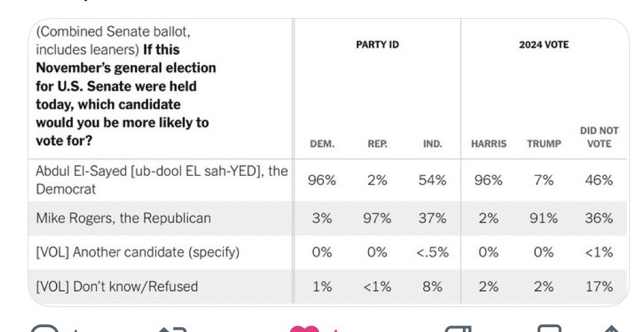
Figure 1: Nov. 1 NYT/Siena Michigan Senate crosstabs — El-Sayed 96% of Democrats, +17 among Independents, and +10 among 2024 non-voters.
In Texas, retail bettors assumed Republicans would easily hold the Senate seat because Texas voted R+14 in 2024, and the Democratic primary nominee, James Talarico, got 31% compared to 50% for Jasmine Crockett in Starr County, the state’s most Hispanic county. The right-wing Twitter users also claimed/heavily weighed the story that Talarico was recently released from a mental institution. Why did retail bears weigh it so heavily? The Texas Senate race was never about the marginal Democratic-leaning crossover votes. It was about the marginal Republican-leaning crossover votes. Talarico’s winning message was anti-corporate economic populism with social moderation. He hired a former staffer of Sen. John Cornyn as his policy director. Talarico flipped trial lawyer Thomas J. Henry, who donated $6.6M to Ken Paxton in the GOP primary. Trump super PAC MAGA Inc. dropped $10 million into Texas in the final week, and Elon Musk tweeted about Talarico and Puerto Rico in the past week—I don’t think he would tweet like that if he didn’t believe Talarico had a real chance of winning in Texas.
The Marist poll showed Democrat James Talarico leading Republican Ken Paxton 50% to 44% for Senate, and Democrat Gina Hinojosa leading Governor Greg Abbott 49% to 46%. The Fox News (Beacon/Shaw) poll was even harsher, showing Talarico leading Paxton 53% to 46% among registered voters (51% to 49% among likely voters). But the crosstab poll was much closer, with Talarico leading Paxton 44% to 40% with 16% undecided. The crosstab poll raised several red flags for Paxton. First, he was only holding 81% of Republicans (with 10% crossing over to Talarico and 9% undecided). Second, voters under 44 backed Talarico 50% to 24%, and 43% of them waited until Election Day to vote.
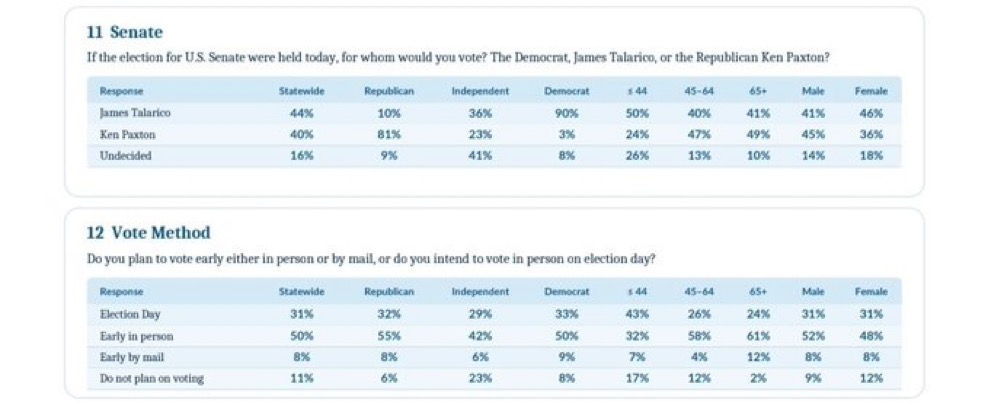
Figure 2: Texas U.S. Senate poll crosstabs — Talarico 44% vs. Paxton 40%, 16% Undecided & Vote Method.
Looking only at raw county totals in the Texas early vote, you might have been tempted to conclude that the 2026 Blue Wave was a mirage. 51.9% of Texas early ballots came from 2024 Trump +5 counties. In the 2026 early vote, under-24 voters surged +104% Democrat and +106% Unaffiliated vs. -12% Republican. 2-of-3 voters surged +96% Democrat and +77% Unaffiliated vs. +3% Republican. Habitual 3-of-3 voters grew +17% Democrat vs. +16% Republican. On Day 8 of Texas early voting, THEO Elections data showed historic shifts that foreshadowed the Blue Wave. In the 2026 Texas early vote, non-primary voters more than doubled their share, rising to 33.1%, while past Republican primary voters dropped to 31.7% (down from 42.6% in 2022), and the primary-history lean shifted from R+11.3 in 2022 and R+9.0 in 2024 to D+0.5. In the Tarrant County SD-09 special runoff, the primary-history lean of early voters in SD-09 swung to D+12.5.
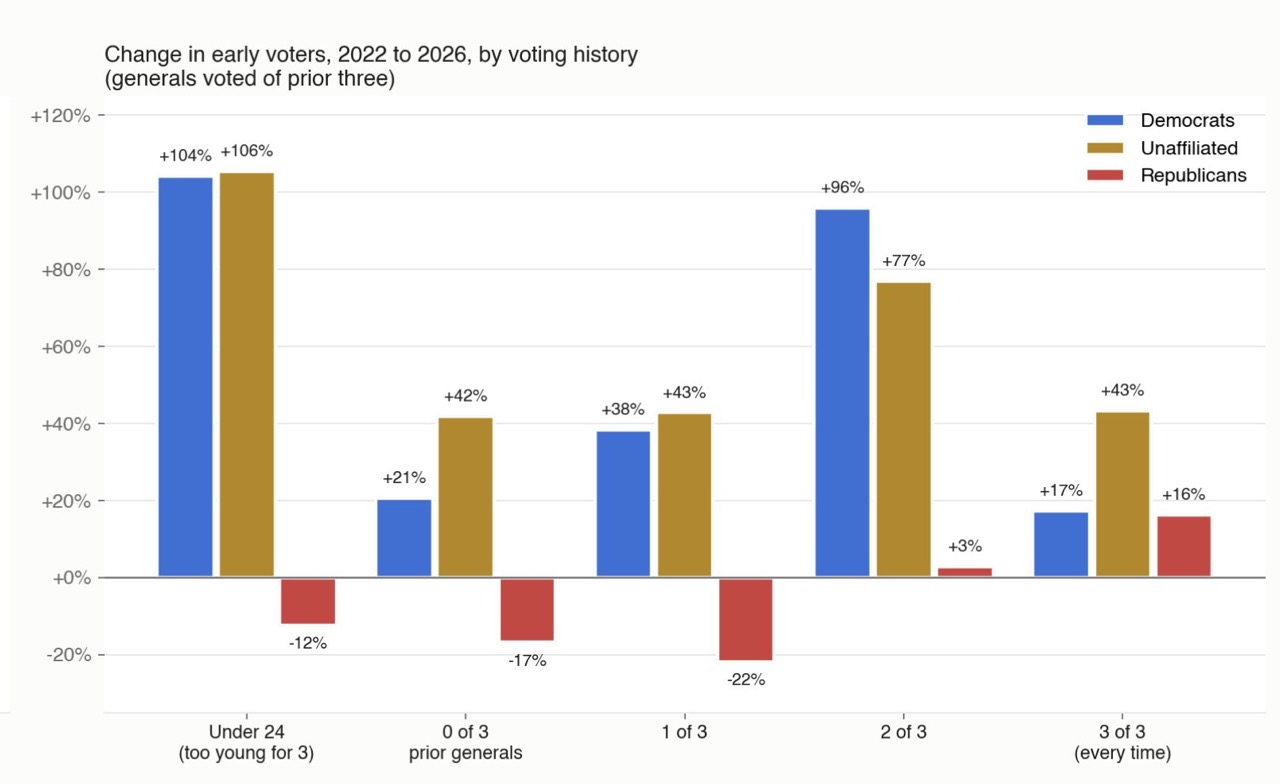
Figure 3: Change in early voters 2022 to 2026 by voting history and age cohort.
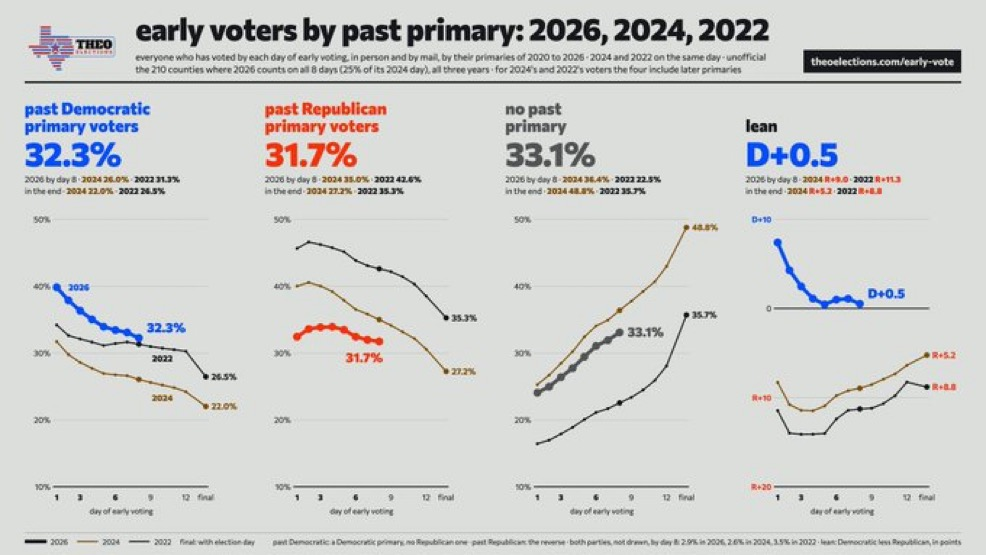
Figure 4: THEO Elections Texas early-vote breakdown by past primary history (Day 8).
When the votes were counted in Texas, Democrat James Talarico swept all seven major metro counties: Harris (+19.1%, +269K votes), Dallas (+37.7%, +306K), Travis (+57.0%, +325K), Bexar (+25.5%, +166K), Tarrant (+9.8%, +71K), Collin (+3.4%, +15.6K), and Denton (+2.1%, +7.9K). In the Texas Governor race, Democrat Gina Hinojosa won with 52.8% of the vote, a 7.1-point victory over incumbent Republican Greg Abbott, who received 45.7% of the vote. Abbott received 4.52M votes (45.7%) this year, essentially the same as his 4.66M votes in 2018 and his 4.44M votes in 2022, while Hinojosa got 5.23M votes compared to Beto O’Rourke’s 3.55M in 2022.
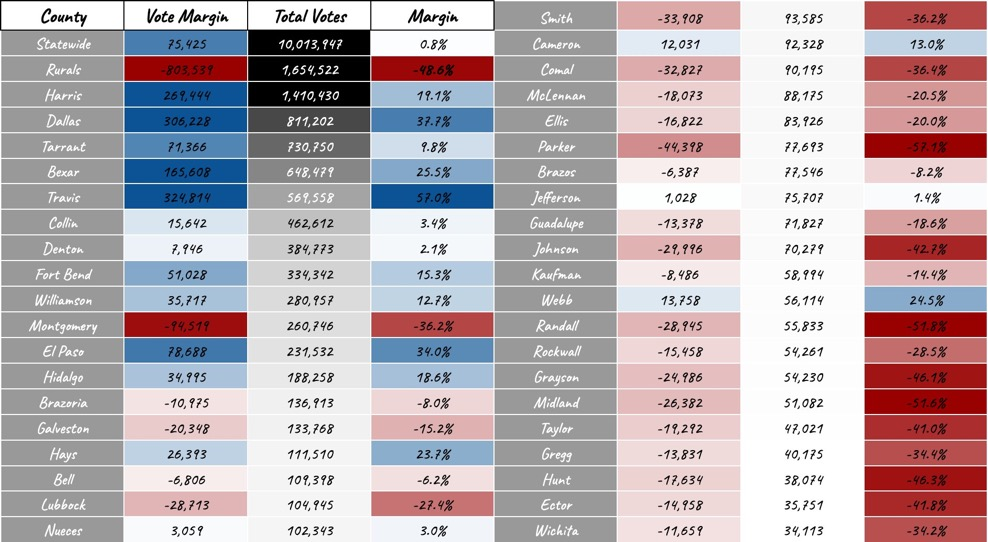
Figure 5: Texas U.S. Senate county-level vote totals and margins across major metro and South Texas counties.
Once early rural Minnesota returns came in on election night, I bought the lagging down-ballot books in Texas, Kansas, Indiana (IN-05), Missouri (MO-02), and North Carolina, and sold into the repricing once Congress and Texas were called. On prediction markets, there is no way to hedge risk across the order book. Each race must be priced and traded individually. This is a problem when races are shifting due to a national trend. Retail bettors are slow to reprice because they only look at the order book for the race they are trading. They are not looking at the big picture. They are not looking at the order books for other races.
After Democrats took the House and Senate, I shorted WTI crude oil futures at $102.20 on 24/7 Hyperliquid perps. Traditionally, you can’t trade futures on election night because the exchange closes the book. But 24/7 Hyperliquid is decentralized and never closes the book, so I was able to trade on the news. My trade thesis was simple: a Democratic House and Senate means the Trump administration’s Iran operation winds down, oil prices decline, and WTI crude oil futures fall. Because of the Iran operation, oil rose above $102 even with Treasury Secretary Scott Bessent—who worked under George Soros and is one of the sharpest macro financiers—keeping crude prices lower, and once the House and Senate flipped Democrat, crude fell to $88.14. I also sold Solana, memecoins, and Hyperliquid tokens days earlier despite the higher gas fees. I went long Bitcoin (and ETH) because the Dem base and lawmakers are anti-AI data centers. They’re pro-crypto regulation, and tech/crypto capital is fleeing altcoins into BTC and ETH in an adversarial regulatory regime.
To price the 2028 Senate map, you need to know the baseline. Tom Wood’s NYT 2026 Senate county vote-share dataset (vs 2024 presidential baseline) shows you exactly that. It’s an invaluable resource that will shape how I think about 2028. James Talarico in Texas ranked #1 among all battleground Senate candidates at D+12.9 over the 2024 baseline, whereas Michigan winner Abdul El-Sayed was the weakest battleground winner at D+3.6. You need to know two things: how macroeconomic conditions will have evolved since 2026 and how low-propensity GOP voter turnout will look in the absence of Trump on the ballot. I think it’s pretty clear that the economy will be worse than it was in 2026. However, I’m running under two assumptions for 2028: that conditions get worse rather than better, and that without Trump on the ballot, low-propensity GOP turnout disintegrates. North Carolina and Wisconsin are low-hanging fruit, Sherrod Brown holds on in Ohio, and considering how close Florida was this cycle, I can see national Dems pouring money into Florida where Ashley Moody will be in trouble if she’s running against a well-funded non-DSA candidate—plus red-state sleepers like Eric Schmitt in Missouri, Mike Lee in Utah, and Kansas if Jerry Moran retires or gets primaried.
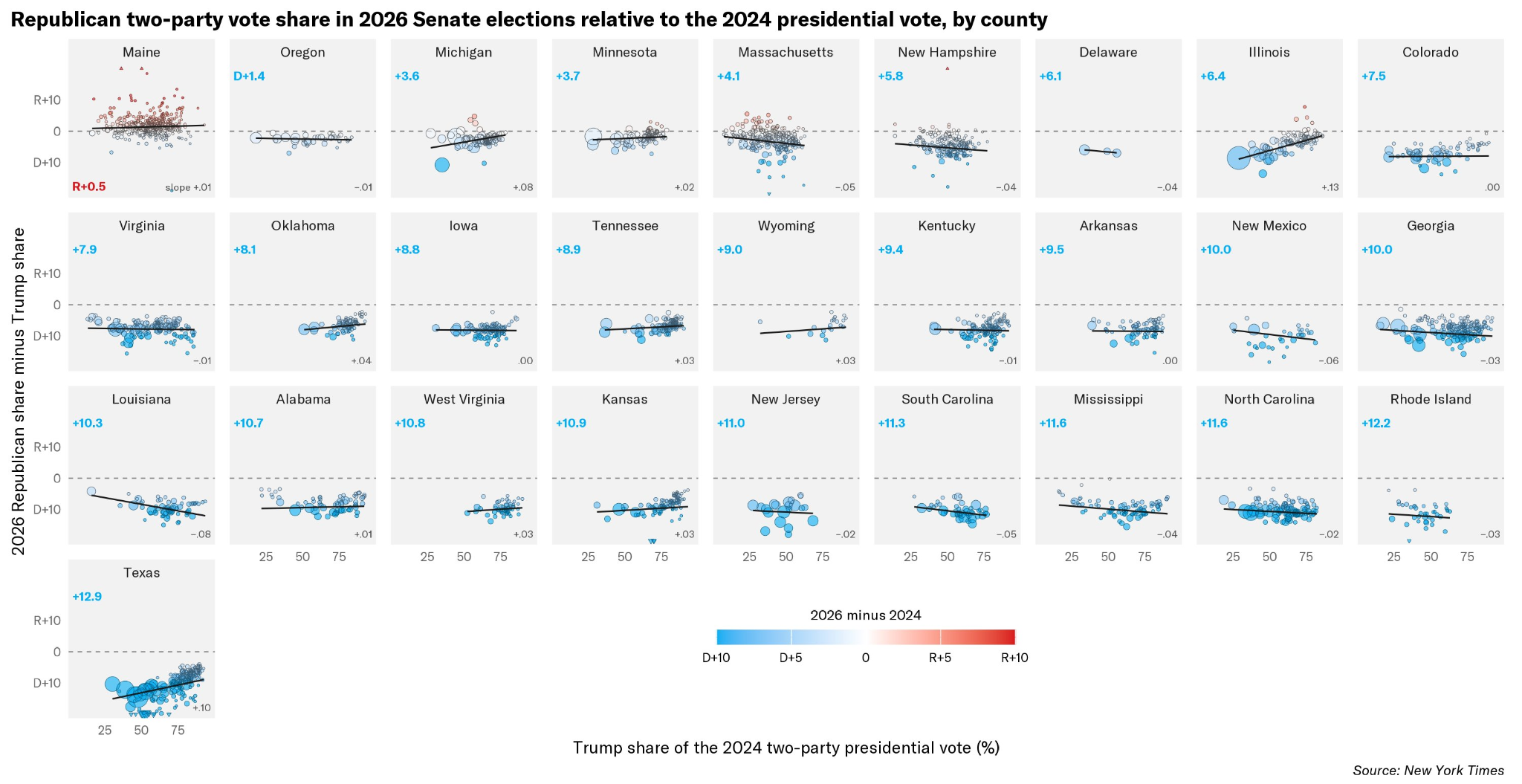
Figure 6: New York Times / Tom Wood 2026 U.S. Senate county-level vote share relative to 2024 presidential baseline.
Robert Zhou studies computational biology at Colby College (Pulver Science Scholar) and works across AI systems, market microstructure, and forecasting. More at robertzhou.dev.