The 10-year Treasury yield hit 5% this week for the first time since 2023. Kate Duguid, Emily Herbert and Ian Smith reported that surging oil prices battered government bonds worldwide, with yields touching 5.01% before easing to 4.98% (FT). Oil continues to rise after Houthi forces suddenly seized the port of Mocha this week, taking Perim Island in the middle of the Bab al-Mandeb Strait soon thereafter. For much of the war, the Red Sea has been the answer to the Strait of Hormuz, but the Houthi advance has crippled that picture. In addition, a drone attack Saudi Arabia believes came from Iraq hit the kingdom’s East-West pipeline to the port in Yanbu, severing another key relief valve in the midst of the ongoing conflict.
Saudi Arabia’s exports are now squeezed on both straits, and so is the global flow of oil. Brent crude jumped as much as 5% to $109.80 a barrel Monday before settling near $105 (FT). Diesel is hitting record prices nationwide. This is a global energy shock landing right before a Fed decision this week, with futures pricing a 91% chance of a rate hike (FT).
Alongside this Middle East mess is another debt story that may worry people more. Gross federal debt just hit $40 trillion, roughly double where it stood a decade ago, and mortgage rates are back near 7%, per Sam Goldfarb (WSJ). Barclays research chairman Ajay Rajadhyaksha said the Treasury’s buybacks have not worked, calling it a problem of the US issuing too much debt for too long (FT). Furthermore, inflation has largely remained slightly elevated since COVID, frustrating consumers given the “soft landing” that was the goal for much of the period. Oil is now adding fresh fuel, and even Japan has raised rates in 2026, something that would have been unthinkable there a decade ago.
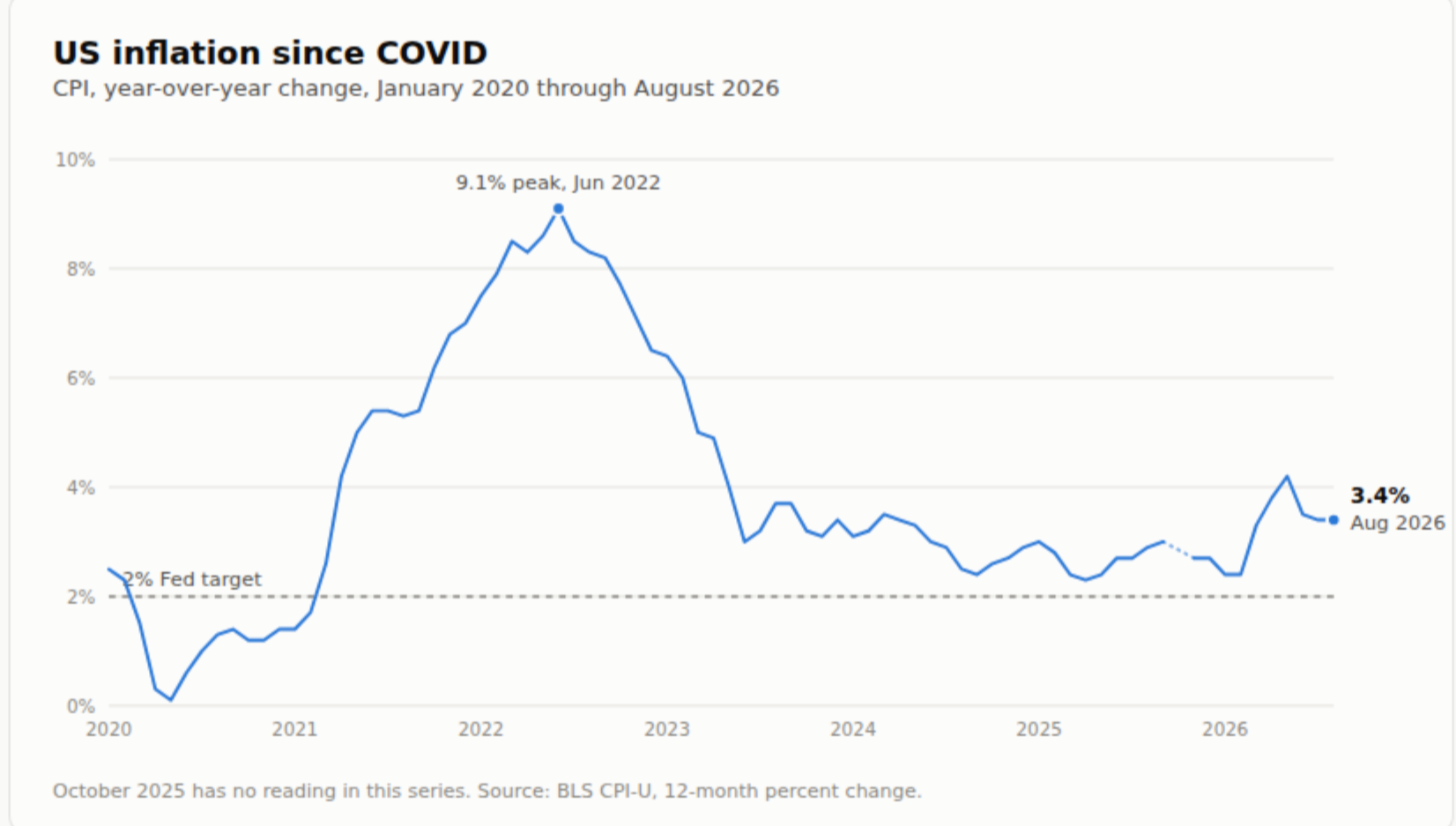
U.S. CPI, year-over-year change, January 2020 through August 2026, shown against the Federal Reserve’s 2 percent target. Data from US Inflation Calculator, historical inflation rates and US Inflation Calculator, current inflation rates.
And lastly, there is AI itself. Dario Amodei published an essay calling for the industry to slow its own pace, and in a rare moment, Sam Altman and Elon Musk both agreed with him, according to Jack Pitcher, Shradha Dinesh and Robbie Whelan (WSJ).

Yemen’s Houthi rebels march during a mobilization campaign in Sanaa, Yemen, Thursday, Sept. 10, 2026. (AP Photo)
Even China’s own state security officials have warned that AI threatens the party’s political control, even as Beijing’s foreign ministry dismissed Amodei’s warnings as fearmongering days earlier.
Microsoft, Alphabet and Meta all rose Monday even as chip stocks got hit and the S&P slipped half a percent. Some argue that with China still in the AI race, there is no real appetite for a slowdown (WSJ).
Markets have shrugged off every pressure they have faced for nearly two years. The real question is whether simultaneous headwinds regarding energy, debt, and the threats of AI are now straining together in a way that is meaningfully structural- and whether markets and society are truly at the breaking point of this trade (for real this time).