
The American frontier labs are still winning the benchmark war and will probably keep winning for a while, but sentiment is shifting toward frontier models, with users questioning whether the high prices are worth it amid capable, cheaper open-source models.
The AI race is undeniably moving at speeds we have never seen before. In the first half of 2025, American developers routed roughly 4.5% of their tokens on OpenRouter to Chinese-built models, a small enough number to be dismissed as merely a curious test of what these models were all about. Now, that share has not fallen below 30 percent in a single week since February 8 of this year, and at its peak it reached 46 percent (CNBC). When a market this young reallocates that much volume in eighteen months, it is not because buyers developed a taste for something new; it’s because expensive products stopped being meaningfully better than the cheap one.
DeepSeek’s V4 Flash, released in April, lists at $0.14 per million input tokens and $0.28 per million output, while Anthropic’s Claude Opus 5 and OpenAI’s GPT-5.6 Sol list at $5 input against $25 and $30 output, respectively; Anthropic’s Fable 5 tier runs to $10 and $50. That works out to a spread of roughly 36 times on the way in and somewhere between 90 and 180 times on the way out, depending on which model you compare against. Although those are the extremes rather than the norm, when measured across the field more broadly, OpenRouter puts Chinese open-source models at 60 to 90 percent cheaper than leading American systems, which is why even American companies like Airbnb and young American startups have switched over. The startups making the switch matter even more than they might seem to, as today’s startups are tomorrow’s industry giants.
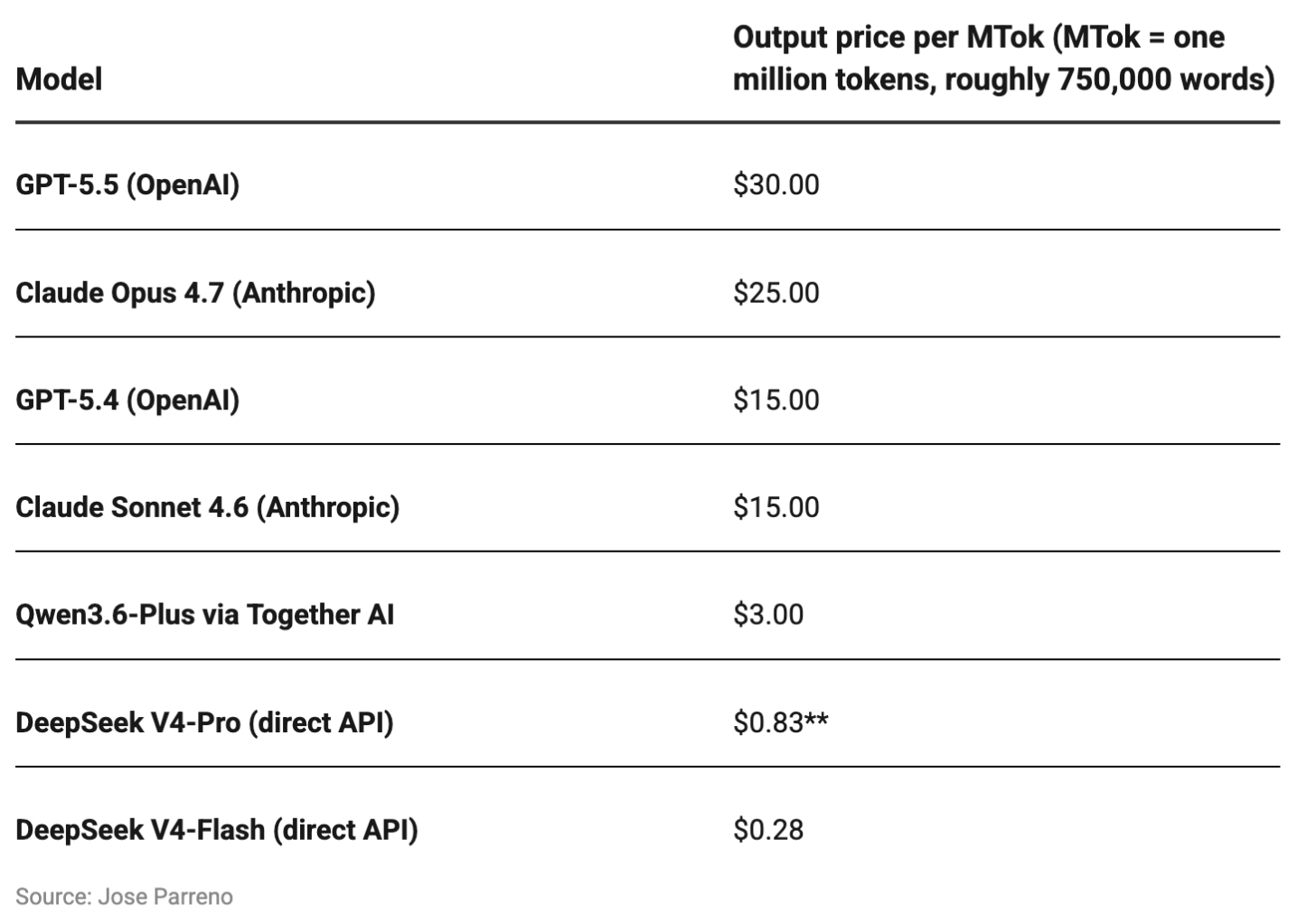
Cheap by itself has never been interesting, because cheap and inadequate is just a worse product at a lower price. What changed is that the capability gap narrowed to the point where taking a discount on open-source models no longer required a real sacrifice. In tests measuring how well AI can handle real software engineering tasks, DeepSeek’s V4 Pro set an open-source record, and its smaller sibling scored almost as high while costing a fraction of what leading American models do (OpenRouter). Z.ai’s GLM 5.2 landed within a single percentage point of Anthropic’s Opus 4.8 on a widely watched agentic benchmark while charging about a fifth as much, and in its first full week on Vercel’s platform its daily token volume grew twenty-sevenfold (CNBC).
And companies aren’t just noticing these numbers: they are acting on them. Lindy, an AI agent startup, moved all of its production traffic off Claude and onto DeepSeek in June, and its chief executive told CNBC the switch would save the company millions of dollars. Vercel’s June production data tells the same story at platform scale, with open-source models handling 29 percent of every token flowing through its gateway, up from roughly one-ninth of that traffic just two months earlier.
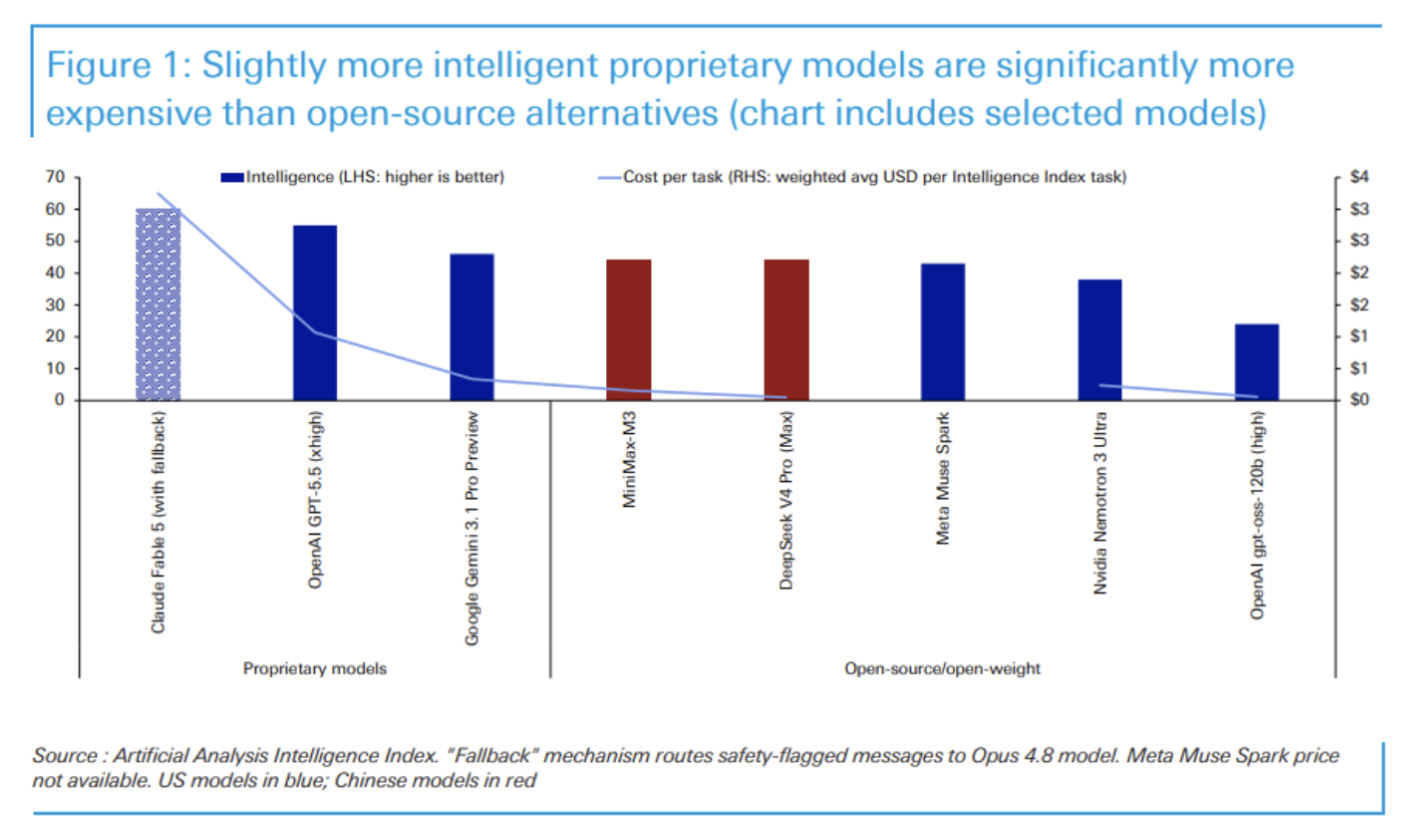
Shockingly, those same open-source models accounted for less than 4 percent of total spending on Vercel’s platform, while the four leading American labs still captured 95 percent of that spending (Zentera). Anthropic reported a $47 billion revenue run rate in May, up from $1 billion seventeen months earlier. Thus, what has migrated to open-source so far is just volume rather than value, and the expensive, high-stakes reasoning work has largely remained with the closed American models.
However, whether that distinction holds is the entire question, as, on a generous reading, the frontier labs are simply giving up cheap commodity work they never wanted, holding on to the premium tasks, and staying six to nine months ahead of the Chinese models. The harsher reading is that six to nine months is not much of a lead at all, since it has to be constantly maintained rather than defended once, and the set of tasks that truly requires frontier capability keeps narrowing with every open-source release.
Ultimately, the pricing behavior is what makes me lean toward the harsher reading. Frontier token prices climbed roughly 12 percent in a single month even as cheaper substitutes poured into the market, and while raising prices in the face of competition can signal real pricing power, it can also signal a company spreading enormous fixed costs across a shrinking base of locked-in customers. The difficult part is that the two stories here can look identical from the outside, until they suddenly don’t, and then it’s too late.