
The tech industry is in the middle of the biggest spending spree in modern history. Last year, companies like Amazon, Google, and Microsoft poured $450 billion into the physical backbone of artificial intelligence. That was just the warm-up. This year, infrastructure spending on chips, data centers, and power is set to hit $900 billion, with forecasts pointing toward $1.4 trillion in 2027 (The Economist). To keep the cash flowing, tech firms have taken on over $400 billion in debt in 2026 alone.
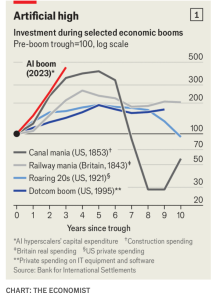 Building all this hardware makes sense if superintelligence is right around the corner, but the financial math is getting tricky. To justify this level of spending, the AI industry would need to pull in about $2.5 trillion in dedicated annual revenue (The Economist). To put that into perspective, $2.5 trillion is more than the entire tech sector brings in combined today.
Right now, actual global revenue from AI services sits at a much more modest $150 billion to $220 billion a year (The Economist). While heavyweights like Anthropic bring in roughly $75 billion annually and OpenAI earns tens of billions, those figures still leave a massive gap between what is being spent and what is coming back in.
The core issue isn’t that people dislike AI, but rather that they use it lightly. Around 20% of American businesses say they use AI tools in some capacity (US Census Bureau). However, workplace adoption has actually cooled off recently. The share of workers using AI on the job fell from a peak of 46% in mid-2025 down to roughly 33% today (The Economist).
Most companies are merely testing the waters rather than making AI a core part of their business. The median firm spends a modest $10.66 per employee each month on AI tools (The Economist). Close to half of the businesses using AI rely entirely on free tiers or open-source alternatives rather than paying for enterprise plans (The Economist). On top of that, roughly 90% of corporate executives report seeing no measurable impact on company productivity over the last three years (The Economist). If companies aren’t saving money or boosting output, they have little reason to pay for expensive software. Instead of creating brand-new markets, much of today’s spending looks like tech companies fighting over the same slice of the pie. Researchers estimate that at least a third of current AI investment is spent simply poaching users from rivals by offering free compute and subsidizing prices, rather than expanding the overall market (The Economist).
For AI to deliver on its promises, businesses will have to do more than just buy a chatbot to help write emails or make presentation slides. They will need to completely rewrite how their teams work from the ground up. Until companies undergo that deep organizational overhaul, the gap between what tech giants spend and what the market actually pays will remain a major risk