
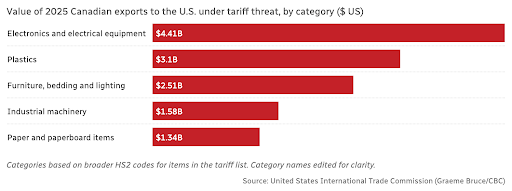
Tariffs have been mostly quiet since February, when the Supreme Court struck down most of Trump’s second-term tariffs. In its place, the administration put a temporary 10% tariff on many imports, which can stay in effect for up to 150 days; that window closes on Friday, July 24. Trump got ahead of it on Monday and added a separate 50% tariff on $20 billion worth of Canadian goods.
More interesting than that number is the law behind the tariffs on Canada. Trump pursued Section 338 of the Tariff Act of 1930, which has never actually been used before. The provision applies when a country is found to be discriminating against American products, and allows the president to act without the months-long investigation Section 301 requires. It is part of the same trade law that helped worsen the trade collapse during the Great Depression. Unlike earlier Canadian tariffs, these apply to goods that are supposed to be protected under USMCA, the trade deal Trump signed during his first term.
The administration’s case of Canada’s discrimination against the US comes down to three complaints. Canada taxes American cars and parts that do not qualify for USMCA, but does not apply this same tax to other countries. Additionally, Canada has a foreign dairy quota; anything beyond it gets hit with a tariff as high as 300%, and European cheesemakers reportedly have a bigger quota than American ones. Finally, most Canadian provinces pulled American alcohol off their store shelves and have not restocked since.
Canadian Prime Minister Mark Carney made the point that Canada did not start this, that the alcohol and auto measures were a response to tariffs Trump put on Canada back in April 2025. He has argued the US broke the USMCA first with these earlier tariffs, which trade lawyers have largely sided with him on. After speaking with Trump this week, Carney said the two had agreed to move trade talks along faster. However, he said Canada is keeping its options open and that Canadians can always buy domestically and open new trade routes elsewhere.
For Americans, the effects of these tariffs will show up in specific areas rather than across the board. Homebuilders and anyone renovating will likely feel it first, since the tariffs hit Canadian building materials, including lumber, which already had existing tariffs. Wine, whiskey, and other imported alcohol will get more expensive, as will dairy products, though the US does not import much Canadian dairy. The average US household is already spending an estimated $550 more annually because of Trump’s tariffs. This number will only get bigger once the more recently announced Section 301 tariffs take effect.