Yesterday, SpaceX released its first quarterly report as a public company. Revenue hit $7.8 billion for the April-to-June quarter, up 92% from a year earlier, against Wall Street estimates of about $6.8 billion, as WSJ’s Micah Maidenberg reports (WSJ). Net loss came in at $541 million. FT’s George Hammond and Rafe Rosner-Uddin put the revenue beat against a $6.82 billion consensus and noted the loss came in far better than the $2.12 billion analysts had modeled (FT).
SpaceX’s unapologetic spending is what unsettled the market. Capital expenditures hit $18.4 billion for the quarter, with $15.8 billion tied to the AI build-out, double the prior quarter (WSJ). CFO Bret Johnsen told analysts that capital spending would remain “very similar” over the next two quarters, per Maidenberg. This, seemingly, puts SpaceX in the same spot as the rest of the AI-buildout cohort. Alphabet and Tesla both saw their share prices fall the week before, after reporting negative cash flow and heavy spending. Google, in particular, is worth flagging, as it raised its 2026 capex guidance to $195-205 billion and had to raise $80 billion in debt to fund data-center expansion. And as a result, investors punished them. SpaceX got a similar treatment. Shares fell more than 10% after the report. Per Hammond and Rosner-Uddin, Melissa Otto of Visible Alpha research at S&P Global told them, “I think what the investment community wasn’t overly excited about was the capex number in the AI segment. It’s ambitious” (FT). Dec Mullarkey of SLC Management told the FT the leasing-heavy model caps upside: “Their margins are going to be capped if they are primarily a cloud company” (FT).
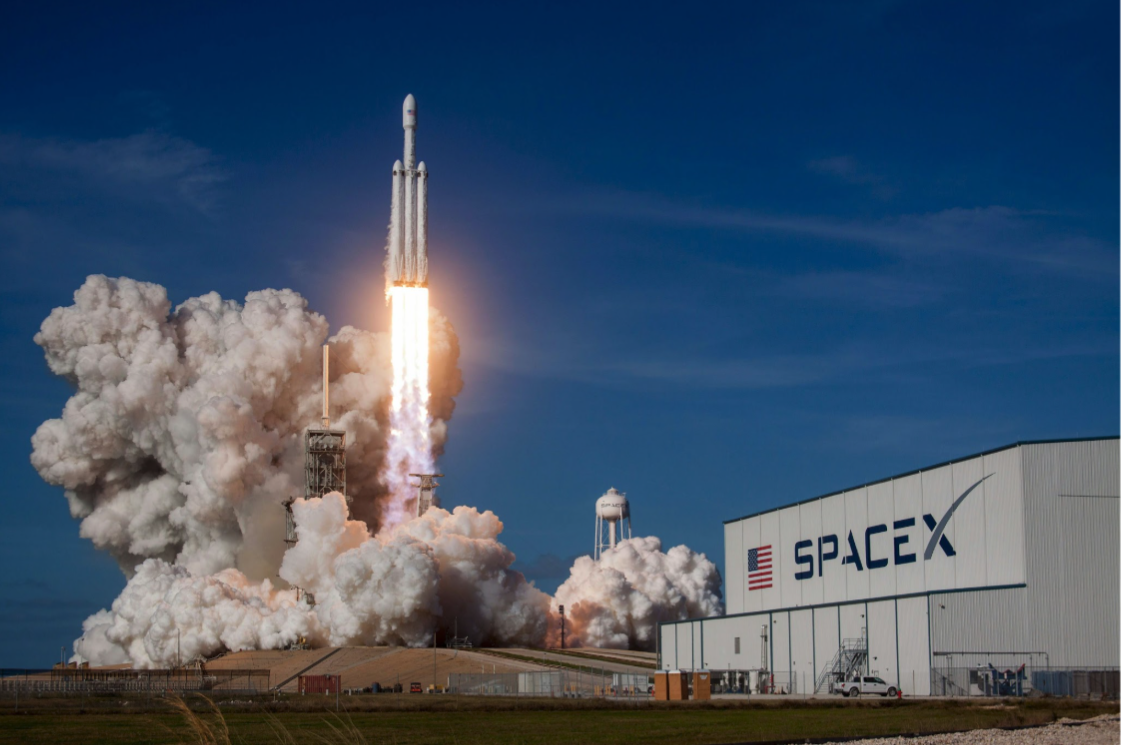
“SpaceX Falcon Heavy Demo Mission.” Unsplash, November 2, 2018
Musk didn’t originally set out to build SpaceX as an AI company. However, he’s realized that AI is a label investors (whether willingly or not) reward with higher valuations right now, and it happens to be a business he can also charge other companies to use, since SpaceX is developing the capacity to rent out data center capacity to firms like Anthropic and Google. On the call, he said, “We are building AI compute capacity at scale faster than anyone else” (FT). That’s the tightrope for Musk now. He is aiming to keep the AI number (and headlines) growing fast enough to hold investor attention, without letting the capex outrun the tangible parts of the business that actually generate cash and justify the valuation on their own.
Starlink is one of those tangible pieces. The connectivity segment of the company, which includes Starlink, generated $4.3 billion in revenue for the quarter, up from $2.6 billion a year earlier (WSJ). Starship is the other. The rocket completed its 13th test flight last month, with another mission planned for August and, per Musk, daily launches “probably” a year out, Maidenberg writes (WSJ). A third is still ahead: Starlink’s push into direct phone connectivity. The service currently handles basic texting through carrier partners, but the real upgrade, broadband-level connectivity to ordinary smartphones, depends on the next generation of satellites that Starship is meant to start launching in 2027. If that lands on schedule, it gives SpaceX a concrete answer to whether it can compete with mobile carriers, not just an AI story to point to. Additionally, such a development would give investors something to look forward to and, in some sense, justify exorbitant expenditures now.
Shares have shed almost half their value from a post-IPO peak of $225. Musk’s bet is that Starlink’s subscriber growth, Starship’s flight cadence, and the phone-connectivity rollout stay real enough to keep funding the AI story long enough for it to become one too.