We are heading back to the consumer, quick-service restaurant (QSR) sector this week with one of our more practical picks: Wingstop. Founded in the not particularly glamorous, industrial-based town of Garland, Texas, in the mid 1990s, Wingstop quickly became one of the largest franchised names in the cooked-to-order chicken wings industry, expanding rapidly across the US and building an incredibly strong brand around wings, seasoned fries, creative sauces, and an all-around simple takeout model.
After 14 years of success, PE firm Roark Capital acquired Wingstop in 2010 with a $36 million debt facility in an ≈$85 million deal. Soon after, in 2015, Wingstop went public on Nasdaq under “WING” and has kept accelerating since through digital ordering, delivery, new openings, and even international expansion. Today, they operate with thousands of locations and relatively few company-owned restaurants.
Beef vs. Chicken
For those who track commodities closely, beef isn’t cheap. As we’ve covered, ground beef is up nearly 57% in the last five years, and the beloved steak hit a record high of $13.06 a pound in July. The US cattle herd is the smallest it’s been in decades, and the Street isn’t expecting relief until the end of 2027 at the earliest. While this has been difficult to digest for many recently, the chicken bulls have quietly been content, with the cost of chicken wings falling and the gap between the two proteins widening.
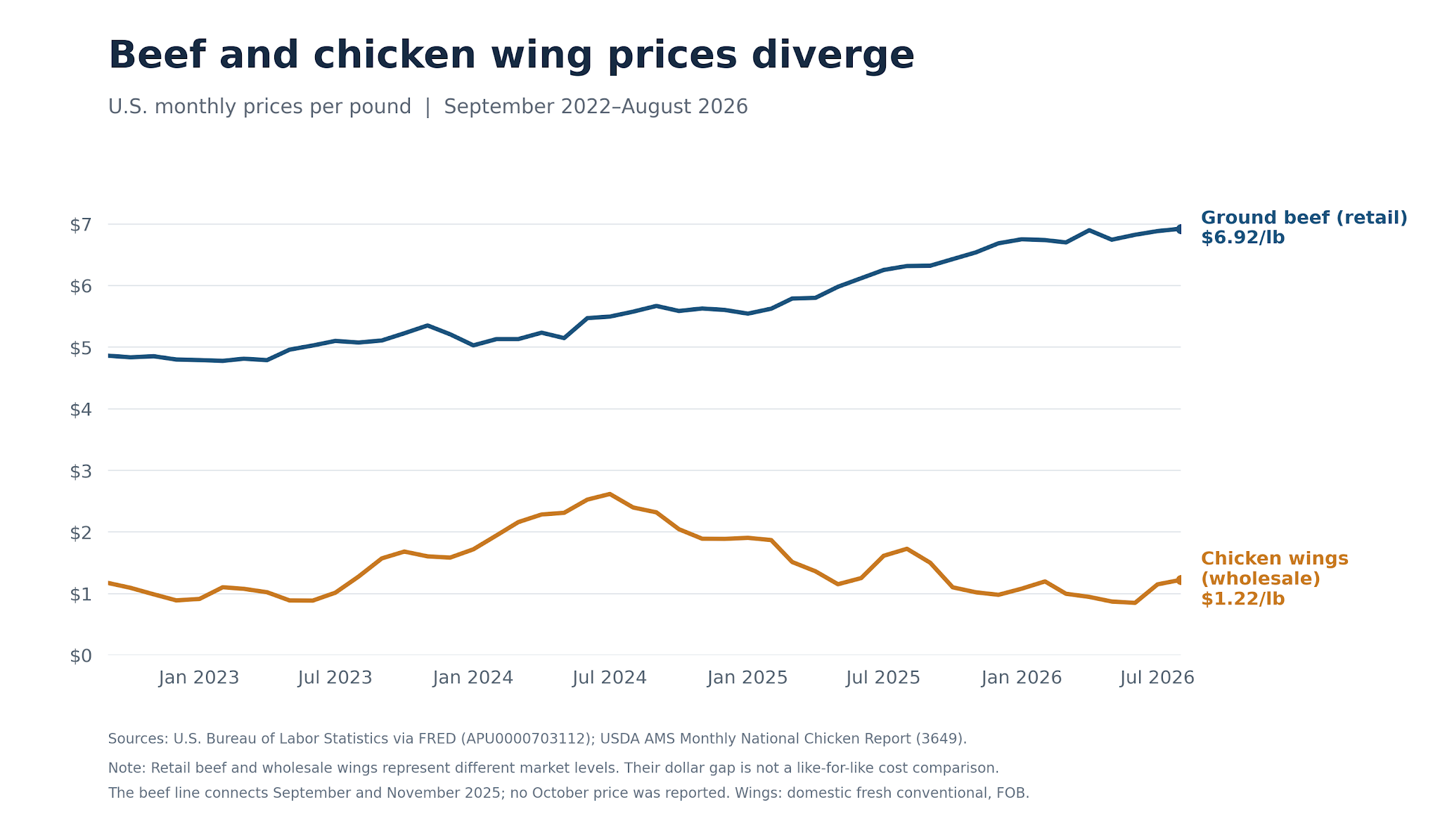
The Street sees these record beef prices as a serious problem for burger chains, which rely on low prices to keep their customer base. While burger meals are getting pricier, chicken meals have gotten cheaper, and price-sensitive customers are already starting to switch. The beef squeeze is a share opportunity for chicken-focused restaurants.
Why-to-Buy
Wingstop opened 102 new restaurants in the second quarter of 2026 and has guidance for 16% global unit growth, supported by a major development pipeline. With 98% of restaurants owned by franchisees, the company needs very little capital to grow. In May, it officially launched nationally, with plans to expand into Poland and India.
It launched nationally in May, and the company plans to use a personalization engine to send targeted value offers to price-sensitive customers instead of broad discounting, a perfect engine for the beef-loving customer who is price-sensitive.
With beef prices expected to remain elevated and Wingstop’s asset-light franchise model continuing to drive expansion, CFR believes that this gap could turn a commodity trend into a meaningful market-share opportunity for Wingstop.