No Off Ramp: Europe’s Energy Shock
In 2022, shortly after Russia’s invasion of Ukraine, the European Union (EU) acted swiftly, cutting a substantial amount of natural gas imports. Russian pipeline gas, which had supplied roughly 40% of EU imports before the invasion, fell to single digits within 2 years (European Commission). As a result, European energy reliance shifted towards liquefied Natural Gas (LNG), supplied by Norway, the United States, and Qatar. Although the EU managed to quickly swap energy “suppliers,” it is now faced with a new problem. As of 2026, a significant share of Europe’s energy supply moves through the Strait of Hormuz, a crucial waterway for oil and gas exports in the Persian Gulf. Due to the ongoing war with Iran and the U.S., and the prolonged closure of the Strait, nearly 20% of the world's LNG has been cut off (The Economist). Qatar, the world's second-largest LNG supplier and a key contributor to global supply, has been fully cut off by the blockade.
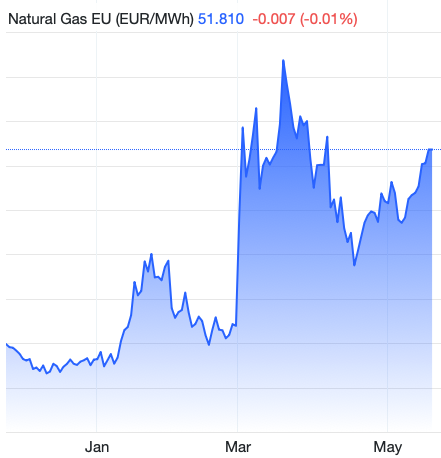
Since the beginning of the blockade, European natural gas prices have risen nearly 40% (New York Times). With the erasure of Qatari LNG from the market and limited global supply, European countries now face higher prices and stiffer competition. Loannis Korras, senior energy market analyst at VaasaETT, noted: “the fuel supply shock” in the Middle East has had a “direct impact on European gas supply, and consequently on retail gas prices” (Euronews). In the past few months, gas prices in Europe have risen by an average of 7%, with cities like Brussels and Berlin climbing to a near 30% (Euronews).
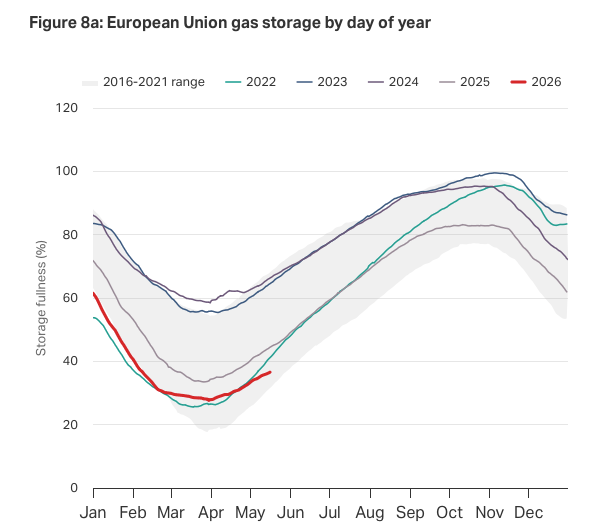
Compounding the problem is what is sitting in Europe's own gas tanks. As of mid-May, EU gas storage was at just 36% of captivity, more than 18 percentage points below the 5-year seasonal average (Gas Infrastructure Europe). Europe is legally required to refill storage to 90% by November 1, and the only window to do it is the April-September injection season. Consequently, the so-called “window” comes at the same months in which Qatari LNG, used to top up reserves, has been cut off by the Hormuz closure. Bruegel’s data shows April LNG imports from the Middle East at their lowest level since 2019 (Bruegel). In response, the EU has tapped emergency oil reserves, spent over 10 billion subsidizing consumer energy bills, joined diplomatic and military efforts to reopen the Strait, and is racing to refill gas storage before winter (New York Times). However, these are all very short-term fixes, and the crisis at large is far from accounted for. As Simone Tagliapietra, an energy and climate analyst at Bruegel, put it, “We are facing a full-fledged oil and gas crisis” (New York Times).
Europe, however, is not an outlier in its energy woes. As a result of the war and broader geopolitical conditions, the energy picture is grim. The Economist notes that global oil reserves at sea, which entered the war near ten-year highs, have now “largely been exhausted," and could become “emptier than ever by June” (The Economist). Europe’s energy shock is one example of wider global issues, but its pivot toward LNG and its reliance on foreign gas have proved especially costly.
If there is any lesson to be drawn from the Hormuz crisis, it is that swapping one set of foreign suppliers for another is not sustainable. For Europe, the question of energy independence is no longer a matter of preference but necessity, one that requires it to look in the mirror.