FIFA's $13 Billion Machine: The Business Behind the World Cup
Overview
This week, North America kicked off the 2026 World Cup. Most viewers' attention is on the games, but the more interesting story is the business behind them.
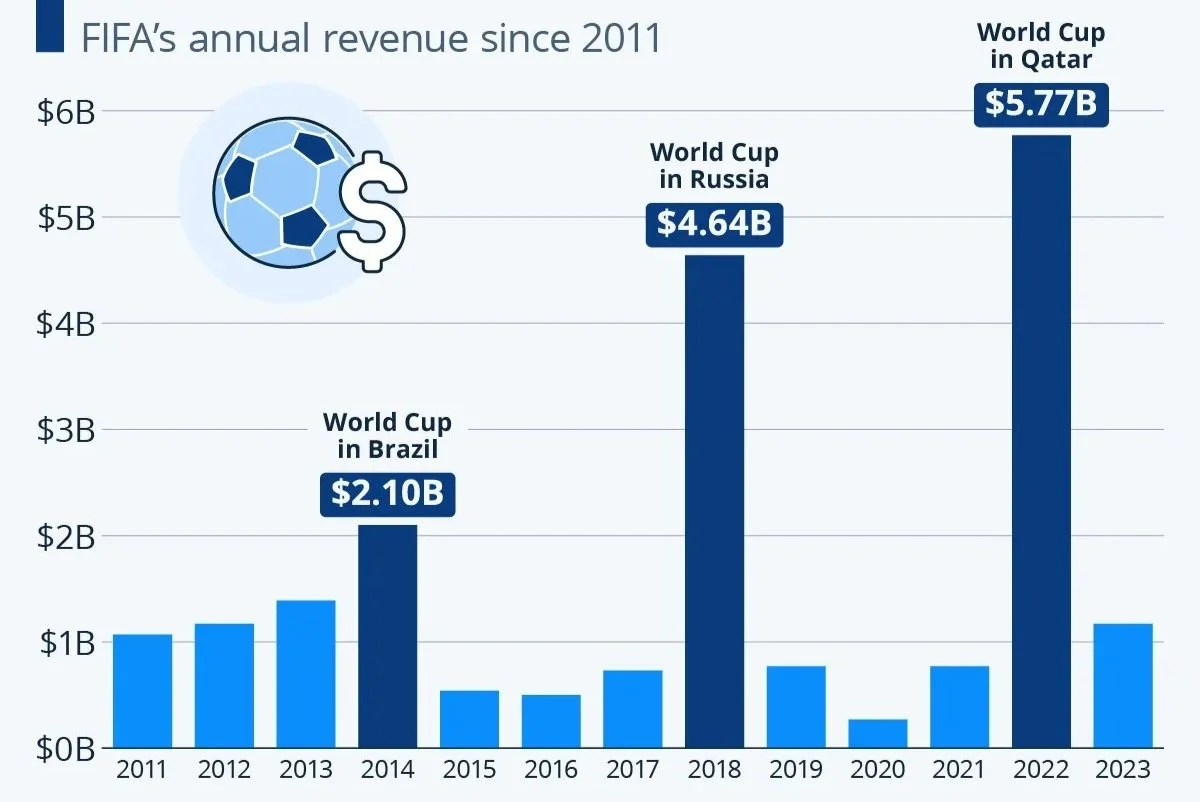
The tournament features 48 teams, 104 matches, and 16 host cities spanning the US, Canada, and Mexico, and it is projected to be the most commercially successful sporting event ever staged. FIFA estimates $8.9 billion in direct revenue from the tournament alone. For context, the 2022 World Cup in Qatar generated $7.5 billion in total revenue across the entire four-year cycle. The jump is not incidental. Expanding the tournament to 48 teams added 16 additional matches compared to 2022, and hosting across three countries unlocked a North American commercial market that simply did not exist at scale for prior tournaments.
How FIFA Actually Makes Money
FIFA's business model is built around a single core asset: it owns the World Cup and licenses access to it across four distinct revenue channels.
Broadcasting is the largest, generating $4.26 billion, roughly 39% of total revenue. Hosting the tournament in the United States proved to be a significant commercial accelerator here, with US broadcasting rights increasing 94% compared to 2022. Hospitality and ticketing follow at $3.1 billion, driven by record attendance demand across 16 venues. Sponsorship rounds out the mix at $2.7 billion. Notably, for the first time in tournament history, all 16 global sponsorship positions were filled, with confirmed partners including Visa, Adidas, Coca-Cola, Hyundai, and Saudi Aramco. Ampere Analysis projects sponsorship revenues could reach $2.4 billion, a 37% increase over Qatar. Each channel reinforces the others: a larger broadcast footprint attracts more sponsors, and a packed sponsorship roster signals commercial legitimacy to the next round of broadcast bidders.
Who Pays and Who Profits
Understanding FIFA's financials requires understanding its structure. FIFA operates as a nonprofit, meaning it pays no dividends and reinvests all surplus revenue back into football through prize funds, development programs, and distributions to member associations worldwide. The 2026 prize pool stands at a record $655 million, up 65% from Qatar, reflecting both the tournament's commercial growth and FIFA's stated commitment to reinvesting that growth back into the sport. Critics have long questioned whether the nonprofit designation accurately reflects how FIFA operates in practice, but the financial flows are real: billions move from broadcasters and sponsors to national federations and development programs each cycle.
The Bigger Picture
What makes FIFA's model exceptional is its capital efficiency. FIFA owns no stadiums, employs no players, and operates no leagues. It controls one asset, the rights to the World Cup, and monetizes it once every four years with virtually no recurring infrastructure costs. Every cycle, five billion viewers tune in. As long as football remains the world's most popular sport, FIFA's model may be the most structurally formidable in all of sports.