America’s Longest Partial Shutdown: A Crisis at the Intersection of Immigration and Economics
How We Got Here
The current shutdown has its roots in a pair of shutdowns in early 2026. The first, which lasted just four days from January 31 to February 3, was resolved when the House passed a short-term funding measure. But negotiations over a longer-term deal quickly collapsed, and on February 14, the Department of Homeland Security (DHS) ran out of funding entirely, triggering the partial shutdown that continues today.
Unlike a full government shutdown, in which virtually all non-essential federal operations come to a halt, this one is targeted. Every other federal agency, including the IRS and national parks, still has funding. DHS stands alone because of a deeply contested debate over immigration enforcement, particularly Immigration and Customs Enforcement (ICE). There has been public outrage over the tactics of ICE, including the unlawful detention, holding conditions, and deaths of two U.S. citizens during a federal immigration operation in Minneapolis. Senate Democrats have demanded reforms to ICE, such as tighter use-of-force standards, a requirement that agents wear body cameras, and a mandate that agents not wear masks. Republicans and the White House, insisting the administration needs broad enforcement authority to execute its immigration agenda, have so far refused these terms.
The Cost
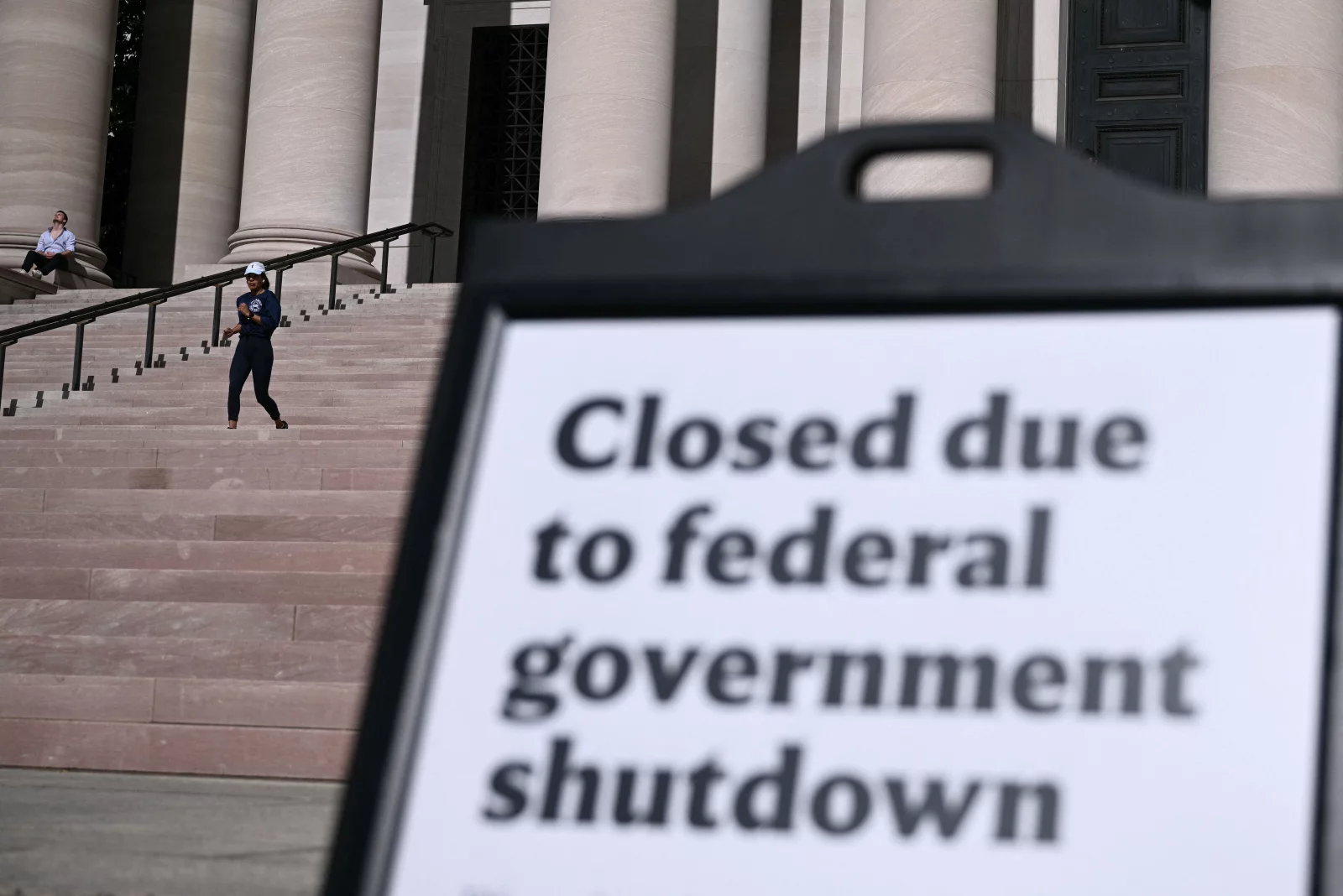
The economic toll is difficult to overstate. Over 100,000 DHS employees, including Transportation Security Administration (TSA) officers, Coast Guard personnel, and the Federal Emergency Management Agency (FEMA) staff, have been working without full paychecks since mid-February. Bloomberg News estimates that shutdowns of this scale cost the U.S. economy roughly $15 billion per week, with a meaningful portion of that representing permanent, unrecoverable losses to GDP rather than simply deferred activity.
The TSA, which employs more than 50,000 officers and is funded under DHS, has taken some of the largest hits, and everyday Americans are feeling it. Since agents went without their first full paycheck, nearly 500 officers have resigned. This is a significant number, especially as spring travel volumes are coming soon. The result has been security lines stretching for more than 2 hours at major hubs, including Atlanta, New York, and Houston, with New Orleans advising passengers to arrive 3 hours before departure. Transportation Secretary Sean Duffy offered a stark warning: “If a deal isn’t cut, you’re going to see what’s happening today look like child’s play,” adding that some smaller regional airports may be forced to temporarily close entirely.

Sean Duffy (Transportation Secretary)
For financial market participants, the shutdown has introduced a quieter but no less consequential disruption: a void in economic data. Bloomberg reports that government shutdowns halt the publication of key federal statistics, including the Bureau of Labor Statistics’ monthly jobs reports and Consumer Price Index figures, leaving the Federal Reserve, investors, and analysts flying partially blind at a moment when monetary policy decisions hinge on precisely this kind of data. Uncertainty over the Fed’s rate path heading into 2026 was already a live debate; the absence of reliable employment and inflation figures compounds it.
A Deal Finally Takes Shape - Sort Of
After nearly fifty days and mounting public pressure, the political gridlock showed its first real signs of breaking in the first week of April. On April 5, the Senate passed a bipartisan funding bill in a remarkable 100–0 vote – the kind of unanimous result that is increasingly rare in today’s polarized Washington. The bill would fund the vast majority of DHS through the end of the year, including the TSA, Coast Guard, FEMA, and the Cybersecurity and Infrastructure Security Agency (CISA). Crucially, however, it carves out ICE and portions of Customs and Border Protection (CBP), whose appropriations remain unresolved due to the ongoing Democratic demand for enforcement reforms.
The two-track strategy now being pursued by Republican congressional leaders would clear the Senate bill first, reopening most of DHS and ending the immediate crisis for federal workers and travelers, and then fund ICE and CBP separately through budget reconciliation. Republicans have set a target of getting that reconciliation bill to President Trump’s desk by June 1.
Meanwhile, President Trump took a parallel step: signing an executive order directing DHS to resume pay for TSA employees regardless of the congressional standoff. The move offered immediate financial relief to tens of thousands of workers but, in itself, does not resolve the underlying funding lapse or reopen the shutdown.
What Comes Next
Even if the Senate bill clears the House and is signed into law in the coming days, the shutdown will not be fully resolved. ICE and CBP will remain in a kind of funding limbo, dependent on the outcome of the reconciliation process and the broader political negotiation over immigration enforcement policy that has driven this crisis from the start. Democrats have not abandoned their demands for ICE reforms, and Republicans have shown no appetite to grant them. The June 1 reconciliation deadline will be the next flashpoint to watch.
For readers focused on the financial implications, the pattern here is worth noting: The United States continues to fund its government through a patchwork of continuing resolutions, short-term deals, and last-minute legislative maneuvering. As the Financial Times and Bloomberg observed in their coverage of prior U.S. fiscal standoffs, this approach introduces chronic uncertainty into an otherwise mature fiscal system, and when it fails, as it has now, the costs are not abstractions. They appear as unpaid workers, grounded operations, missing economic statistics, and the slow erosion of institutional credibility, which is difficult to price but very real.