Google and SpaceX’s Bet on Orbital Data Centers
One of the major challenges facing the AI industry in Silicon Valley is neither funding nor computing hardware; rather, it is space. Data centers have become power-hungry to the point that their energy consumption rivals that of small towns, and the issue of where to locate them has become a critical challenge for the tech industry. The power supply networks in Virginia’s North, Scandinavia, and Singapore have already reached their peak capacity, and the new locations are met with strong local opposition due to concerns about heat generation, noise pollution, and water consumption.
According to recent reports, Google and SpaceX may be close to an agreement to launch data centers into space. It appears that Google is planning to introduce Project Suncatcher. This is an effort to create an AI cloud by networking satellites powered by the sun and fitted with Tensor Processing Units in orbit. With some prototypes in mind and plans to cooperate with Planet Labs, Google expects the launch by 2027.
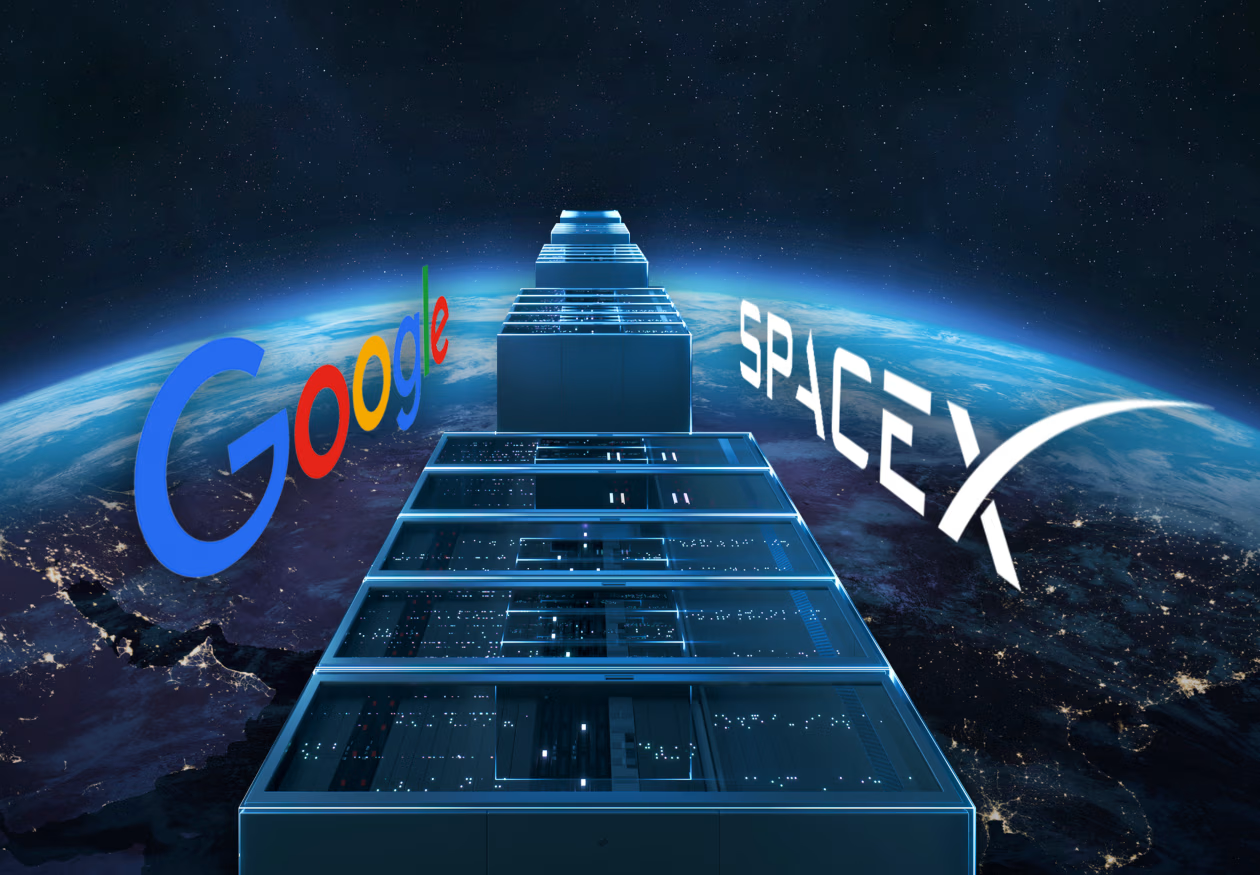
SpaceX seems to have picked the ideal time for this partnership, as the company prepares for the biggest IPO in American history, which could value it at up to $2 trillion by late 2026. In other words, the company needs a compelling story to justify its high valuations, and things recently took a turn. SpaceX has merged with Elon Musk's AI company, xAI, and thus acquired its Memphis data center, which houses more than 220,000 Nvidia GPUs and over 300 megawatts of compute power. Last week, Anthropic reached an agreement to lease all this capacity. An eventual partnership with Google would be the best deal SpaceX could get to prove its capabilities.
As mentioned above, critics can rely on numbers to argue that orbit is not the ideal solution at the moment. For instance, it appears that the cost of creating and launching orbital data centers is much higher than that of building similar facilities on Earth. However, as launch costs decrease, the overall cost will decrease as well, and SpaceX is making this exact bet. Moreover, there is always the possibility of uncontrolled satellite collisions, which could make the entire low Earth orbit unsuitable for further development.
However, one more thing should be mentioned here. OpenAI, of which Musk was a founding member, was created specifically to compete with Google in AI. It appears that the feud between Musk and Google CEO Larry Page became one of Silicon Valley's greatest rivalries. Thus, an official SpaceX-Google partnership would represent a significant reconciliation and a move forward toward the next frontier. In other words, both former rivals can pursue the trillion-dollar IPO together.